

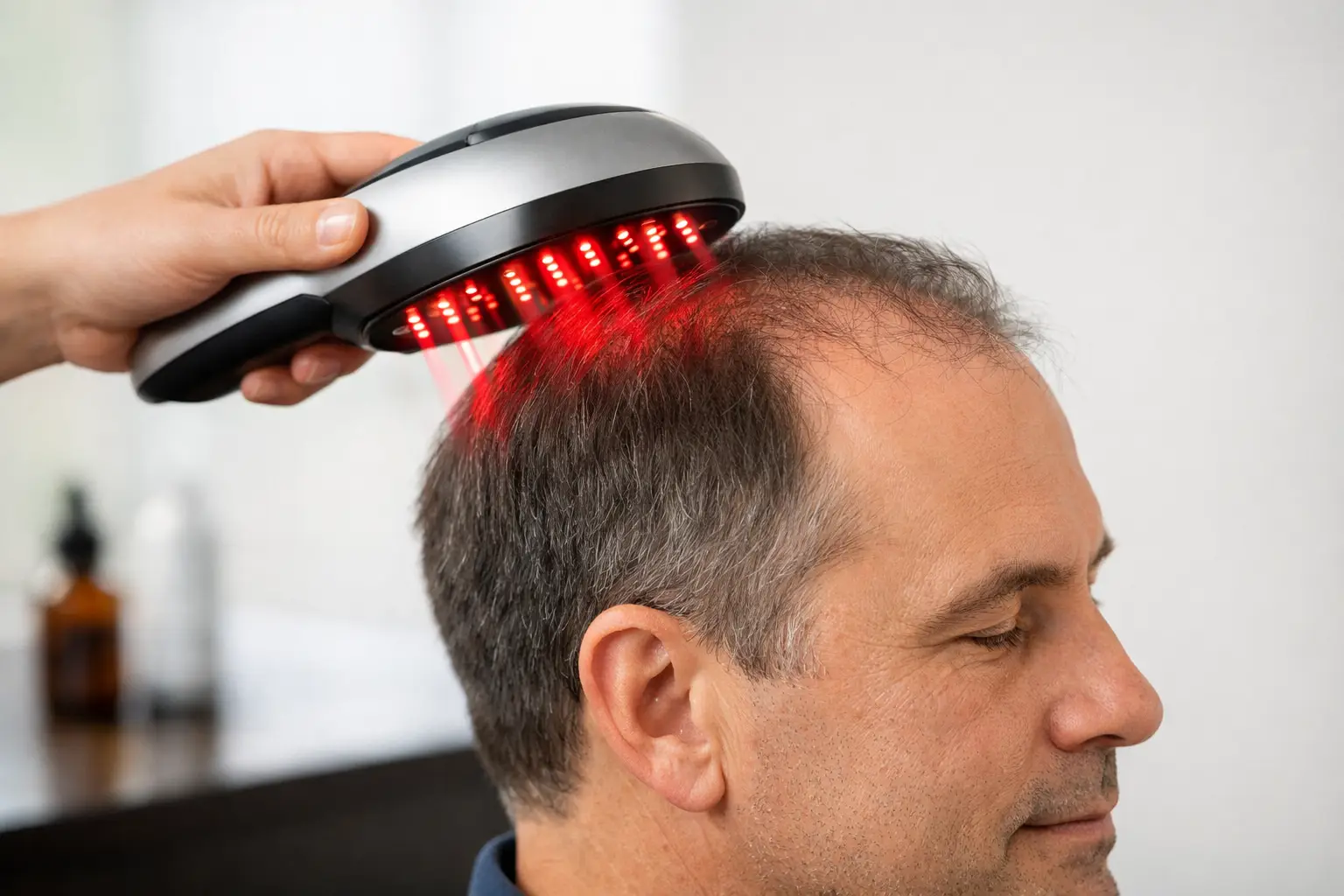
If you have started seeing more scalp at the part line, more shedding in the shower, or less density under bright office lighting, the question gets personal fast: can laser therapy regrow hair? For many people, the honest answer is yes, to a degree – but not in every case, and not as a stand-alone fix for every type of hair loss.
Low level laser therapy, often called LLLT, is one of the most popular non-surgical options for thinning hair because it is painless, drug-free, and easy to fit into a routine. It is also one of the most misunderstood. Some people expect dramatic regrowth on fully bald areas. Others dismiss it too quickly because they assume anything this gentle cannot work. The reality sits in the middle.
Can laser therapy regrow hair or just slow hair loss?
Laser therapy can help regrow hair when follicles are still alive but underperforming. In practical terms, that usually means early to moderate thinning rather than long-standing shiny baldness. The light energy is used to stimulate the scalp and support follicles that have become weaker, smaller, or stuck in a shortened growth cycle.
That matters because hair loss is not always a simple on-or-off switch. In many cases, follicles do not disappear overnight. They miniaturize over time, producing finer, shorter hairs before they stop producing visible hair at all. LLLT is most useful during that window, when there is still follicular activity to support.
For people with male or female pattern hair loss, laser therapy may improve hair density, strengthen existing strands, and encourage some regrowth. For people with advanced baldness where follicles are no longer active, expectations need to be more realistic. Laser therapy may support scalp health, but it is unlikely to recreate a full head of hair in areas that have been bare for years.
How low level laser therapy works
Low level laser therapy uses specific wavelengths of light directed at the scalp. Unlike surgical lasers, these devices do not burn or damage tissue. The goal is stimulation, not destruction.
The proposed mechanism is straightforward. Light energy reaches the scalp and is absorbed by cells in and around the hair follicle. That energy may help improve cellular activity, circulation, and the environment needed for hair growth. It can also help move follicles into a longer growth phase, which is important because thinning hair often spends less time actively growing.
You can think of it as support for sluggish follicles rather than a miracle reset. If the follicle is still capable of producing hair, improving its environment can make a visible difference. If the follicle is gone, light therapy cannot bring it back.
This is why specialist assessment matters. Two people may both say, “I’m losing hair,” but one may have pattern thinning that responds well to laser therapy, while another may have scarring alopecia, nutritional issues, postpartum shedding, or medical hair loss that calls for a different plan.
Who is most likely to see results
The best candidates are usually men and women with early to moderate thinning, especially pattern hair loss. These clients often still have widespread follicles across the scalp, even if the hair looks finer and less dense than before.
Laser therapy can also appeal to people who want a non-invasive option or who are not ready for medication, transplantation, or more intensive procedures. It is often used by professionals who want a discreet treatment with no downtime and no obvious signs of having had something done.
There are also cases where laser therapy works best as part of a broader treatment strategy. Someone with diffuse thinning may benefit more when LLLT is paired with scalp-focused treatments, medical guidance, or cosmetic solutions that improve appearance while natural hair is being supported.
People tend to see less benefit when hair loss is very advanced, when the scalp is smooth and bare, or when the underlying cause has not been identified. If hair loss is being driven by hormones, inflammation, illness, severe stress, or nutrient deficiency, the trigger still needs attention.
What kind of results are realistic?
This is where expectations need to stay grounded. Laser therapy usually produces gradual improvement, not overnight change. The earliest signs are often reduced shedding, stronger-feeling hair, or better texture before obvious visible regrowth appears.
Most people who respond well notice that their hair looks fuller, especially in areas that have thinned rather than gone completely bare. Part lines may look narrower. The crown may appear less sparse under direct light. Hair may become easier to style because individual strands are thicker and healthier.
That said, results vary. Some people see moderate regrowth. Others mainly preserve the hair they still have, which is still valuable. Slowing progression can make a major difference over time, especially if treatment begins early.
Consistency is a major factor. Missing sessions or stopping too soon often leads people to assume the treatment failed, when the real issue was insufficient treatment frequency or duration. Hair growth is slow by nature, and even effective treatments need time.
How long does laser therapy take to work?
Most people need several months before they can fairly judge results. A common timeline is around three to six months for early changes, with fuller assessment at six to twelve months. Hair grows in cycles, so improvements do not show up all at once.
This delay can be frustrating, especially when hair loss feels urgent. But it is normal. A treatment that supports the follicle still has to wait for the hair cycle to catch up. That is why professional follow-up, progress photos, and scalp assessment are useful. They help track subtle improvements that are easy to miss in the mirror.
Maintenance is usually part of the picture as well. Pattern hair loss is progressive, so once results are achieved, ongoing sessions may be needed to keep the scalp and follicles supported.
Is home laser therapy as effective as in-clinic treatment?
Home devices can be convenient, and for some people they are a practical part of long-term maintenance. The challenge is not just the device itself. It is diagnosis, consistency, treatment parameters, and whether the person using it is actually a good candidate.
In-clinic treatment offers a more controlled approach. It also gives you access to specialist evaluation, which is often the difference between a reasonable investment and a disappointing one. If the scalp is inflamed, the hair loss pattern suggests another cause, or the thinning is too advanced for laser therapy alone, a professional can identify that early.
This is where a company like HairSpec can be helpful. A full-spectrum hair specialist can look beyond a single device and recommend whether LLLT should stand alone, support another treatment, or be replaced by a more suitable option.
When laser therapy should be combined with other treatments
Hair loss rarely follows a neat script. One person may need only supportive stimulation. Another may need cosmetic density now and restorative treatment over time. That is why combination planning is often more effective than relying on one method.
For example, someone with active thinning but a very visible scalp may use laser therapy to support natural growth while also exploring non-surgical hair replacement or scalp micropigmentation for immediate cosmetic improvement. Someone with medically related shedding may need treatment timing adjusted around recovery. Someone with advanced hairline loss may get better value from transplant planning, with laser therapy used to support existing hair.
The key point is that LLLT is a tool, not a universal answer. Used in the right setting, it can be very worthwhile. Used in the wrong setting, it can feel underwhelming.
Safety and side effects
Low level laser therapy is generally well tolerated. It is non-invasive, does not require anesthesia, and usually involves little to no downtime. That is one reason it is attractive to people who want gentle treatment and privacy.
Side effects are uncommon, but that does not mean every case should be self-managed. If you have scalp conditions, sudden heavy shedding, patchy hair loss, or medical concerns, the safest move is to get an expert opinion before starting. Hair loss can be cosmetic, medical, or both.
So, can laser therapy regrow hair?
Yes, laser therapy can regrow hair for the right candidate – especially when thinning is caught early, follicles are still active, and treatment is used consistently. It can also help preserve existing hair and improve overall density, which for many people is the result that matters most.
The more useful question is not just whether it can work, but whether it is the right fit for your type of hair loss, your timeline, and your expectations. When treatment is matched to the real cause of thinning, the path forward becomes much clearer. If you are noticing changes now, getting your scalp assessed early gives you more options and a better chance of keeping the hair you still have.