

Hair thinning rarely announces itself all at once. More often, it shows up under bathroom lighting, in photos taken from above, or when a once-reliable part line starts looking wider than it used to. For many women, that shift feels personal and difficult to explain. Scalp micropigmentation for women is one of the most effective non-surgical ways to reduce that visible contrast and create the appearance of fuller, denser hair.
Unlike treatments that try to regrow hair, scalp micropigmentation focuses on appearance. It places detailed pigment impressions into the scalp to replicate the look of hair follicles or reduce the visibility of scalp show-through. When performed well, the result is subtle. People usually notice that the hair looks fuller, not that a procedure was done.
What scalp micropigmentation for women actually does
Women usually experience hair loss differently from men. Instead of a fully bald area, many women see diffuse thinning across the top, crown, or part line. That means the goal is not a shaved-head effect. In most female cases, the treatment is used to add visual density beneath existing hair.
This is why scalp micropigmentation for women requires a different design approach. The pigment must match the natural depth of the hair color, skin tone, and density pattern. The practitioner also has to respect how women wear their hair day to day, whether that is a center part, side part, fringe, tied-back style, or layered cut. Small placement decisions make a major difference in how natural the result looks.
Done properly, the treatment creates an optical effect. By softening the contrast between hair and scalp, thinning areas appear less exposed. This can make the part line look narrower and the crown look more even. For women who are bothered by patchy visibility rather than total loss, that visual correction can be significant.
Who is a good candidate
The best candidates are usually women with mild to advanced thinning who still have some hair coverage but want better-looking density. This includes women with hereditary thinning, postpartum changes that did not fully recover, traction-related thinning, or hair loss linked to stress or medical conditions. It can also help women who have had a transplant and want more density between existing hairs.
That said, suitability depends on the cause and stability of the hair loss. If the scalp is actively inflamed, highly sensitive, or affected by an untreated medical issue, it may be better to address that first. Women with certain forms of scarring alopecia may still be candidates, but the skin must be evaluated carefully because scar tissue and inflamed tissue respond differently.
This is where a proper consultation matters. A specialist should look at the scalp closely, ask about hair loss history, assess the pattern of thinning, and determine whether micropigmentation should stand alone or be combined with another service. At HairSpec, that treatment-planning approach is especially important because not every woman needs the same solution, even when the concern looks similar on the surface.
What the treatment process looks like
Scalp micropigmentation is usually completed over multiple sessions rather than in one visit. This allows the practitioner to build density gradually and adjust the tone and layering with precision. For women, that gradual approach is often the safer choice because subtlety matters more than bold coverage.
At the first appointment, the scalp is mapped and the target zones are identified. Pigment selection is based on the natural hair root shade, not just the visible hair length. This matters because many women color their hair, and the scalp impression should blend with regrowth and natural shadow rather than the cosmetic color alone.
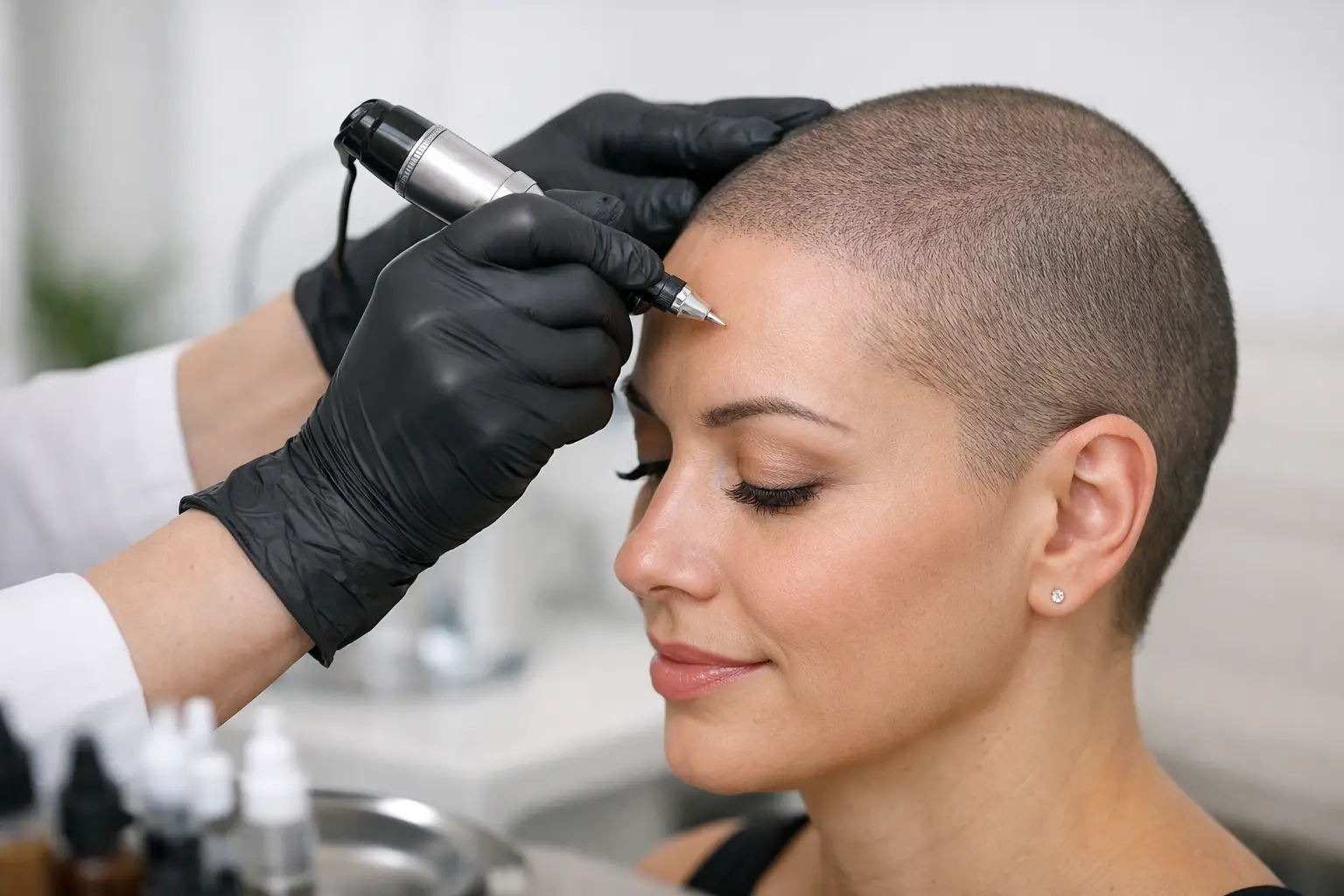
During treatment, a specialized device deposits tiny pigment impressions into the upper scalp layers. Most clients describe the sensation as tolerable, though comfort levels vary depending on scalp sensitivity and the area being treated. Sessions are spaced out to allow the pigment to settle before the next layer is added.
The number of sessions depends on the amount of thinning, desired density, and how the skin retains pigment. Some women need only light enhancement along the part line. Others need broader work through the top and crown. The right endpoint is not the darkest possible finish. It is a believable finish that still looks natural in daylight, office lighting, and tied-back hairstyles.
What results to expect
The most common misconception is that scalp micropigmentation makes hair grow back. It does not. What it does is improve the visual impression of fullness, which for many women is the main concern they want solved.
Results are often best seen in the mirror rather than in dramatic before-and-after language. A part line may look softer. A sparse crown may look less obvious. Styling may feel easier because the scalp no longer stands out so strongly under direct light. These are cosmetic improvements, but they can have a real impact on confidence and daily routine.
There are trade-offs. If thinning progresses significantly over time, the treatment may need to be adjusted so the density effect stays balanced with the remaining hair. Women who frequently change hair color may also need guidance on choosing a pigment tone that ages well across different looks. This is one reason a conservative plan often works better than chasing immediate darkness.
Scalp micropigmentation vs other hair loss solutions
For women comparing options, the right choice depends on whether the goal is regrowth, coverage, or both. Scalp micropigmentation is best viewed as a cosmetic density solution. It does not replace medical treatment when the scalp needs medical support, and it does not replace hair systems or wigs when fuller coverage is required.
If a woman wants to treat early thinning, low level laser therapy, mesotherapy, or medical evaluation may be part of the conversation. If she wants instant volume and complete styling flexibility, a topper, wig, or hair replacement option may make more sense. If she has enough donor hair and is suitable for surgery, a transplant may also be discussed.
Where micropigmentation stands out is in its low-maintenance, non-surgical nature. There is no daily adhesive, no added hair piece, and no need to rely on fibers or concealers every morning. For women who want their own hair to look better without adding another styling step, that can be a strong advantage.
Concerns many women have before booking
One of the biggest fears is ending up with visible dots or an artificial look. That concern is valid. Poor technique, wrong pigment choice, or over-saturation can make the scalp look flat or obvious. Female scalp micropigmentation should never look harsh. It should mimic soft depth beneath the hair, not create a stamped pattern.
Another common concern is whether the scalp must be shaved. In most female density treatments, the answer is no. The treatment is typically performed around existing hair, although the exact prep depends on the area and hair length. That makes it far more approachable for women who want privacy and minimal disruption to daily life.
Longevity is another question. Results do fade gradually, and touch-ups are usually needed over time. How long that takes depends on skin type, sun exposure, lifestyle, and pigment retention. This is normal. A gradual fade is often preferable because it allows refinements as hair color, density, or style preferences change.
Choosing the right provider matters more than the technology alone
Many clinics can describe the device. Far fewer understand the female scalp well enough to create believable density. Women need a provider who can assess hair loss pattern, plan around existing hair, and take a restrained approach to placement and layering.
Experience matters, but so does judgment. The provider should be honest about whether micropigmentation is the right answer, whether it should be combined with another service, and what level of improvement is realistic. That kind of consultation protects the outcome.
For women dealing with thinning hair, the best solution is not always the most aggressive one. Sometimes the right treatment is the one that gives you back a more balanced, natural appearance without changing your routine or making your hair loss feel more visible than it already does.
If your scalp is showing more than you want and styling tricks are no longer enough, a thoughtful consultation can bring clarity. The right plan should fit your hair, your comfort level, and the way you want to look when you walk out the door each morning.