

When people start comparing fue vs fut hair transplant options, the question is rarely just about technique. It is usually about privacy, downtime, hairstyle flexibility, and how natural the result will look months from now. Those details matter because a hair transplant is not only a medical procedure. It is also a personal decision tied to confidence, appearance, and daily life.
If you have been researching hair restoration, you have probably noticed that both FUE and FUT can produce strong results in the right candidate. The better choice depends on your hair loss pattern, donor supply, styling habits, recovery expectations, and long-term plan. There is no universal winner. There is only the method that makes more sense for your scalp, goals, and lifestyle.
FUE vs FUT hair transplant: the core difference
The main difference between FUE and FUT is how donor hair is collected from the back or sides of the scalp.
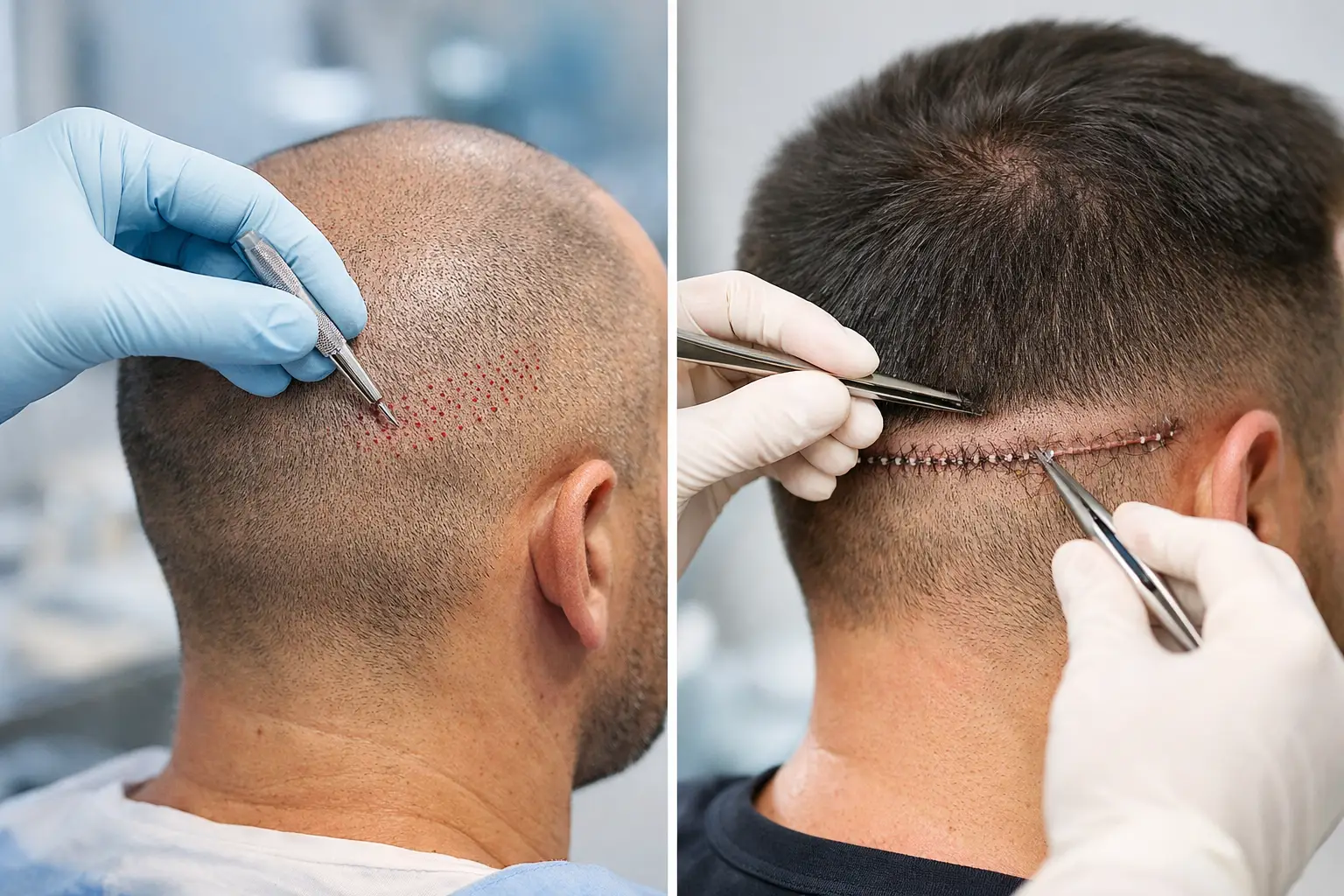
In FUE, or follicular unit extraction, individual follicular units are removed one by one using a very small punch tool. These grafts are then placed into thinning or balding areas. Because the extraction is spread out, FUE usually leaves many tiny dot-like scars rather than one linear scar.
In FUT, or follicular unit transplantation, a thin strip of scalp is removed from the donor area. That strip is then dissected into individual grafts under magnification before implantation. The donor area is closed with stitches or staples, which means FUT typically leaves a single linear scar.
Both methods transplant your own hair. Both aim to create natural growth in areas affected by thinning. The difference is not the basic goal. It is the harvesting method, and that affects healing, graft numbers, and how you may want to wear your hair afterward.
Who usually leans toward FUE
FUE often appeals to people who want to keep their hair shorter or who are especially concerned about visible scarring. Because the scars are small and dispersed, they are often harder to detect when the hair is clipped short, although they are not invisible.
This method can also feel more attractive to patients who want a less invasive image of surgery. There is no strip removal, and for many people that sounds easier to accept emotionally. Recovery in the donor area can also feel more comfortable for some patients, especially in the first days after treatment.
That said, FUE is not automatically the best option for everyone. It may require shaving a larger donor area, and in some cases the number of grafts that can be harvested efficiently in one session may be lower than with FUT. The process can also be time-intensive depending on the case.
Who usually leans toward FUT
FUT is often considered when a patient needs a larger number of grafts and has good scalp laxity. Because the grafts come from a strip, surgeons can sometimes obtain a high yield of quality grafts in a single session.
For patients who plan to keep their hair longer at the back, the linear scar may be less of a concern. In those cases, FUT can be a practical option, especially when maximizing donor hair is a priority.
FUT may also preserve the surrounding donor area differently, which can matter in a long-term restoration plan. Hair loss is often progressive. If future sessions may be needed, donor management becomes an important part of the conversation, not an afterthought.
Scarring and hairstyle flexibility
Scarring is one of the biggest reasons people compare FUE and FUT so carefully.
With FUE, the scarring appears as many small marks across the donor area. These usually heal as tiny white dots. If the procedure is done well and healing goes smoothly, they may be difficult to notice under short hair. Still, if someone shaves very closely, the pattern can sometimes be visible.
With FUT, the scar is usually a line across the donor region. If the hair is worn at a moderate length, it may stay hidden quite well. If you like very short fades or buzz cuts, however, the scar may become easier to see.
This is where lifestyle matters more than theory. Someone who always wears their hair longer may do very well with FUT. Someone who wants the freedom to cut their hair short may feel more comfortable with FUE. Neither concern is superficial. Your preferred hairstyle is part of how you live with the result every day.
Recovery time and comfort
Both procedures involve healing, temporary scabbing in the recipient area, and a waiting period before visible growth begins. Hair transplantation is not instant gratification. New growth typically takes months, and the final cosmetic outcome takes patience.
With FUE, donor discomfort is often described as milder because there is no strip incision. Patients may still experience tenderness, swelling, and sensitivity, but the donor area generally heals as many small extraction points.
With FUT, the donor area may feel tighter or more uncomfortable early on because the scalp has been sutured closed. Activities that stretch the scalp can be more noticeable during recovery. Stitches or staples also add a different element to aftercare.
That does not mean FUT recovery is unmanageable. Many patients recover well. It simply means the healing experience is different, and some people strongly prefer one approach over the other once they understand what recovery actually feels like.
Graft numbers and coverage goals
If your hair loss is limited and you want to restore a hairline or fill smaller thinning areas, either method may be suitable depending on donor quality and design goals.
If your hair loss is more advanced, the conversation becomes more strategic. FUT may allow efficient harvesting of a larger number of grafts in one session. That can be useful when broader coverage is needed.
FUE can also achieve significant coverage, but planning matters. Overharvesting the donor area can create a thinner appearance at the back and sides if not managed carefully. A good surgical plan should protect the donor area while also creating a believable density in the recipient area.
This is why the best consultations look beyond the front hairline. They assess current loss, likely future loss, donor density, hair caliber, scalp condition, and whether you may benefit from combining or sequencing treatments over time.
Cost differences
FUE is often more expensive per graft because the extraction process is meticulous and labor-intensive. FUT may be more cost-effective in some clinics, especially for larger sessions.
But headline price should not be the only factor. What matters is value relative to your goals. A lower-priced procedure that leaves you unhappy with scarring, density, or long-term planning is not really a bargain.
It also helps to remember that transplant surgery is only one part of hair restoration for many people. Some patients benefit from medical support, scalp treatments, low-level laser therapy, scalp micropigmentation, or non-surgical density solutions to improve the overall cosmetic result. A specialist who can evaluate the full picture tends to give more balanced advice.
Is one method more natural-looking?
This is a common concern, and the answer is reassuring. Natural-looking results come more from graft placement, hairline design, angle, density planning, and surgeon skill than from whether the grafts were harvested by FUE or FUT.
A poorly designed FUE transplant can look unnatural. A well-executed FUT transplant can look excellent. The technique matters, but execution matters more.
That is why a thoughtful consultation is so important. Good planning accounts for your age, facial proportions, ethnicity, hair characteristics, and likely future hair loss. The goal is not simply to add hair. It is to create a result that still makes sense years from now.
FUE vs FUT hair transplant: how to decide
If you are deciding between the two, start with a few practical questions. Do you want to wear your hair very short? Are you trying to maximize graft numbers in one session? Are you comfortable with a linear scar if it stays hidden under longer hair? How important is a potentially easier donor recovery? How advanced is your hair loss, and what might you need later?
You should also consider whether a transplant is the right first step at all. Some people come in focused on surgery when a non-surgical option may be more suitable, especially if the hair loss is diffuse, medically related, or still unstable. At HairSpec, that broader view is important because the right solution is not always the most aggressive one.
The most useful answer is rarely FUE or FUT in isolation. It is the recommendation that fits your scalp, your schedule, your comfort level, and your long-term appearance goals.
A good hair restoration plan should leave you feeling informed, not pressured. If you are weighing these options, look for a specialist who explains the trade-offs clearly, evaluates donor supply honestly, and treats your result as a long-term design decision rather than a quick fix. The best choice is the one that still feels right after the procedure is over and real life resumes.