

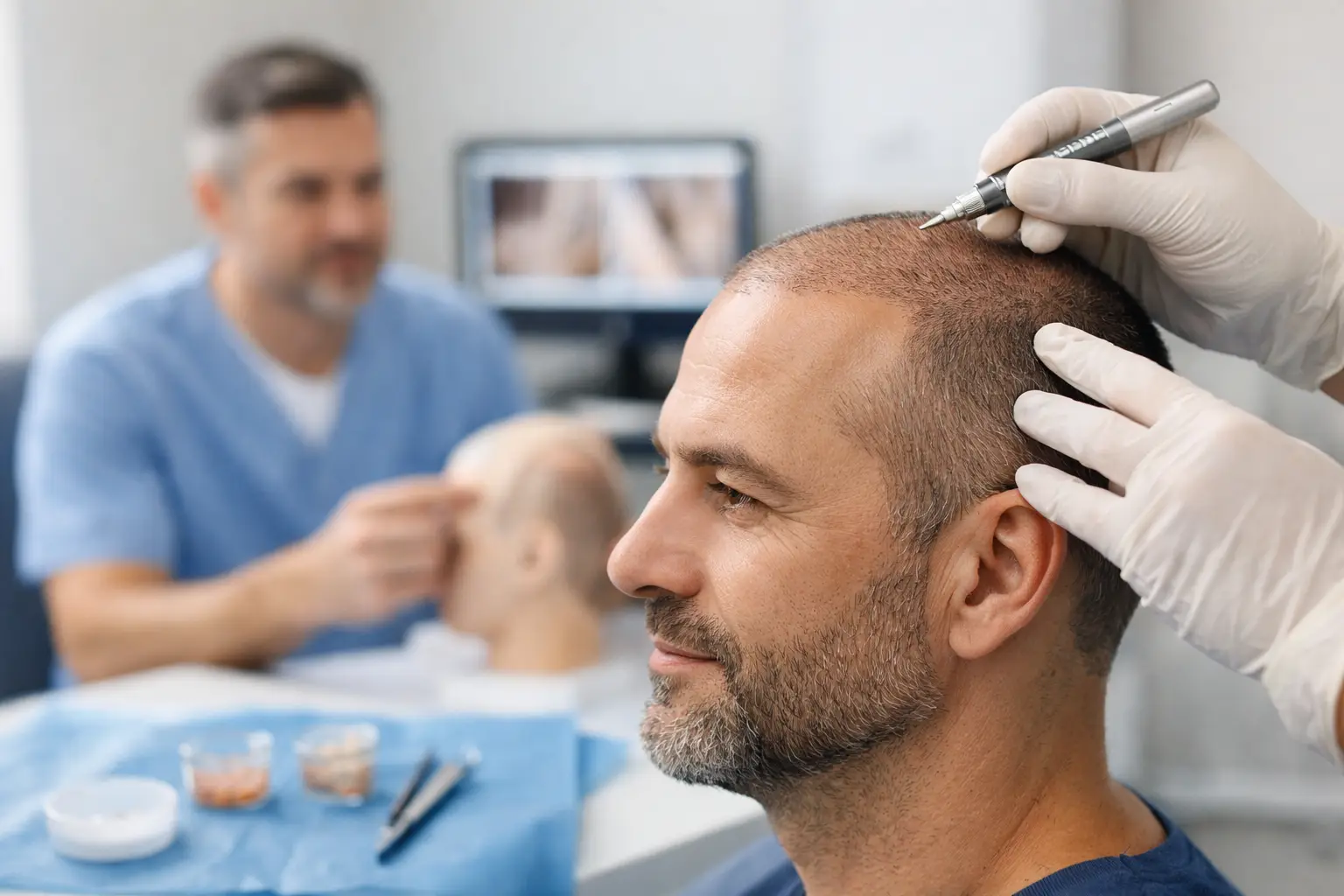
A thinning hairline can change the way you approach mirrors, photographs, meetings, and social occasions. A guide to FUE hair transplant should do more than explain how follicles are moved from one area to another. It should help you understand whether surgery matches your pattern of hair loss, expectations, lifestyle, and long-term plan for maintaining your appearance.
Follicular unit extraction, or FUE, is one of the most recognized modern hair transplant techniques. It can create natural-looking density when it is carefully planned and performed on the right candidate. It is still surgery, though, and the best outcomes begin with honest assessment rather than a promise of an instantly fuller head of hair.
What Is an FUE Hair Transplant?
FUE is a surgical method of harvesting individual follicular units from a donor area, usually the back and sides of the scalp. A follicular unit may contain one to four hairs. These grafts are then placed into carefully prepared recipient sites in areas affected by thinning or baldness.
Unlike older strip-based transplant methods, FUE does not involve removing a linear strip of scalp. Instead, the surgeon extracts grafts one by one using a small punch tool. This usually leaves tiny, dot-like scars that can be less noticeable once healed, particularly when hair is kept at a short-to-medium length.
That does not mean FUE is scar-free or automatically the best choice for every person. The visibility of donor marks, the number of grafts available, and the final cosmetic result all depend on factors such as scalp characteristics, hair caliber, curl pattern, skin tone, donor density, and surgical technique.
Who Is a Good Candidate for FUE?
A strong candidate has a stable enough donor supply and a realistic understanding of what that supply can achieve. The donor area is not unlimited. Each graft removed is a graft that cannot be replaced, so responsible planning protects the donor zone as well as the appearance of the transplanted area.
FUE may be suitable for men and women with pattern hair loss, receding hairlines, thinning at the crown, or selected areas of scarring. It can also be considered for people who prefer to avoid a linear donor scar or who typically wear shorter hairstyles. However, suitability is never based on hairstyle preference alone.
Hair loss that is progressing quickly requires particular care. Transplanting too aggressively into a young or unstable hairline can create an unnatural look later if surrounding native hair continues to thin. In some cases, a specialist may recommend medical management, low-level laser therapy, scalp micropigmentation, or a non-surgical hair replacement solution before surgery, or alongside it.
A personalized scalp and hair assessment should examine the pattern and cause of hair loss, the quality of the donor hair, scalp health, family history, medications, and medical conditions. For women, diffuse thinning can be more complex than a clearly defined receding hairline. A careful diagnosis matters before any graft plan is discussed.
How FUE Hair Transplant Planning Shapes Results
The procedure itself matters, but design is what makes a transplant look believable years from now. A natural hairline is rarely straight or uniformly dense. It has irregularity, variation in direction, and a gradual transition from finer single-hair grafts at the front to fuller graft groupings behind it.
Your specialist should consider your age, facial proportions, current and predicted hair loss pattern, and preferred styling routine. A lower hairline may sound appealing, but it uses more grafts and may not suit future hair loss. Conserving grafts can be the wiser decision when coverage is needed across a larger area.
Density also needs perspective. A transplant redistributes existing hair rather than creating new donor hair. The goal may be improved framing at the hairline, stronger visual coverage through the mid-scalp, or strategic work at the crown. Trying to achieve youthful density across a very large bald area can overtax the donor region and compromise a natural finish.
What Happens During the Procedure?
On the day of treatment, the donor area is usually trimmed so the surgical team can access and extract grafts accurately. Local anesthesia is used to keep the scalp comfortable during the procedure. Depending on the number of grafts and areas being treated, FUE may take several hours and sometimes requires more than one session.
After extraction, grafts are inspected and kept in controlled conditions before placement. The surgeon creates recipient sites at angles and directions intended to match the growth pattern of your existing hair. Grafts are then placed into those sites, with particular attention to the hairline and other highly visible areas.
You should expect a degree of swelling, tenderness, and temporary redness after surgery. These effects are common, but individual recovery varies. Your provider should give clear instructions on washing, sleeping position, exercise, sun exposure, medication, and when you can return to work or social activities.
Recovery: What the Timeline Really Looks Like
The first two weeks are about protecting the grafts and allowing the scalp to heal. Small scabs commonly form around the recipient and donor sites. They should be handled only as directed, rather than picked or scrubbed away. Most people can return to desk-based work relatively soon, but visible redness or scabbing may influence how private you wish to be during this period.
Transplanted hairs often shed within the first few weeks. This can feel discouraging, but it is a common part of the process. The follicles remain beneath the skin and typically enter a resting phase before new growth begins.
Early regrowth may appear around three to four months, often fine at first. More noticeable change usually develops from six months onward, while maturation can continue for 12 months or longer. Crown work may take longer to show because of the direction and density required in that area.
Patience is not a marketing phrase in hair restoration. It is part of the treatment timeline. Anyone offering a fixed promise of immediate density or identical results for every client should be approached with caution.
Risks and Trade-Offs to Discuss Before Surgery
FUE is generally considered a minimally invasive transplant technique, but it carries risks. These can include infection, bleeding, swelling, numbness, temporary shock loss of existing hair, poor graft growth, uneven density, visible donor depletion, and scarring. A careful provider discusses these possibilities before treatment, not after.
Shock loss deserves special attention if you have fine or miniaturizing native hair around the treatment zone. Existing hairs can shed temporarily after surgery, and in some cases may not fully recover. This is one reason why a transplant plan may include measures to support the hair you still have.
Cost should also be viewed as more than the price per graft. Ask what is included in the quoted treatment plan, who performs each part of the procedure, how graft numbers are estimated, and what aftercare is provided. The lowest quote is not always the best value if planning, surgical oversight, donor preservation, or follow-up support are limited.
Questions to Ask at an FUE Consultation
A consultation should leave you clearer, not pressured. Ask whether your hair loss is stable, how many grafts are recommended and why, what density is realistically achievable, and how the plan accounts for future thinning. Request an explanation of donor management, expected scarring, recovery time, and the qualifications of the team involved.
It is also reasonable to ask whether surgery is the right first step. A specialist with access to multiple treatment pathways can recommend what fits your needs rather than forcing every concern into a transplant solution. For some people, non-surgical hair replacement provides immediate coverage. For others, scalp micropigmentation can create the appearance of greater density, either alone or as a complement to a transplant.
At HairSpec, a private scalp assessment can help clarify the cause and pattern of hair loss before you commit to a treatment path. The right solution is the one that respects both your goals now and the hair you may need to manage in the future.
An FUE transplant can be a meaningful investment in confidence when the donor supply, design, and recovery plan all align. Give yourself permission to ask detailed questions, compare recommendations, and choose care that feels medically sound as well as personally right.