

A hair transplant is not simply a choice between two techniques. It is a decision about how much donor hair you have available, how you wear your hair, the amount of coverage you need, and what recovery fits realistically into your life. When comparing FUE versus FUT transplant, the right answer is rarely the same for everyone.
Both procedures move healthy, permanent hair follicles from a donor area, usually the back and sides of the scalp, to areas affected by thinning or baldness. Both can create natural-looking, lasting results when planned carefully. The meaningful differences are how grafts are collected, the type of scarring involved, and which patients each technique tends to serve best.
FUE versus FUT transplant: the core difference
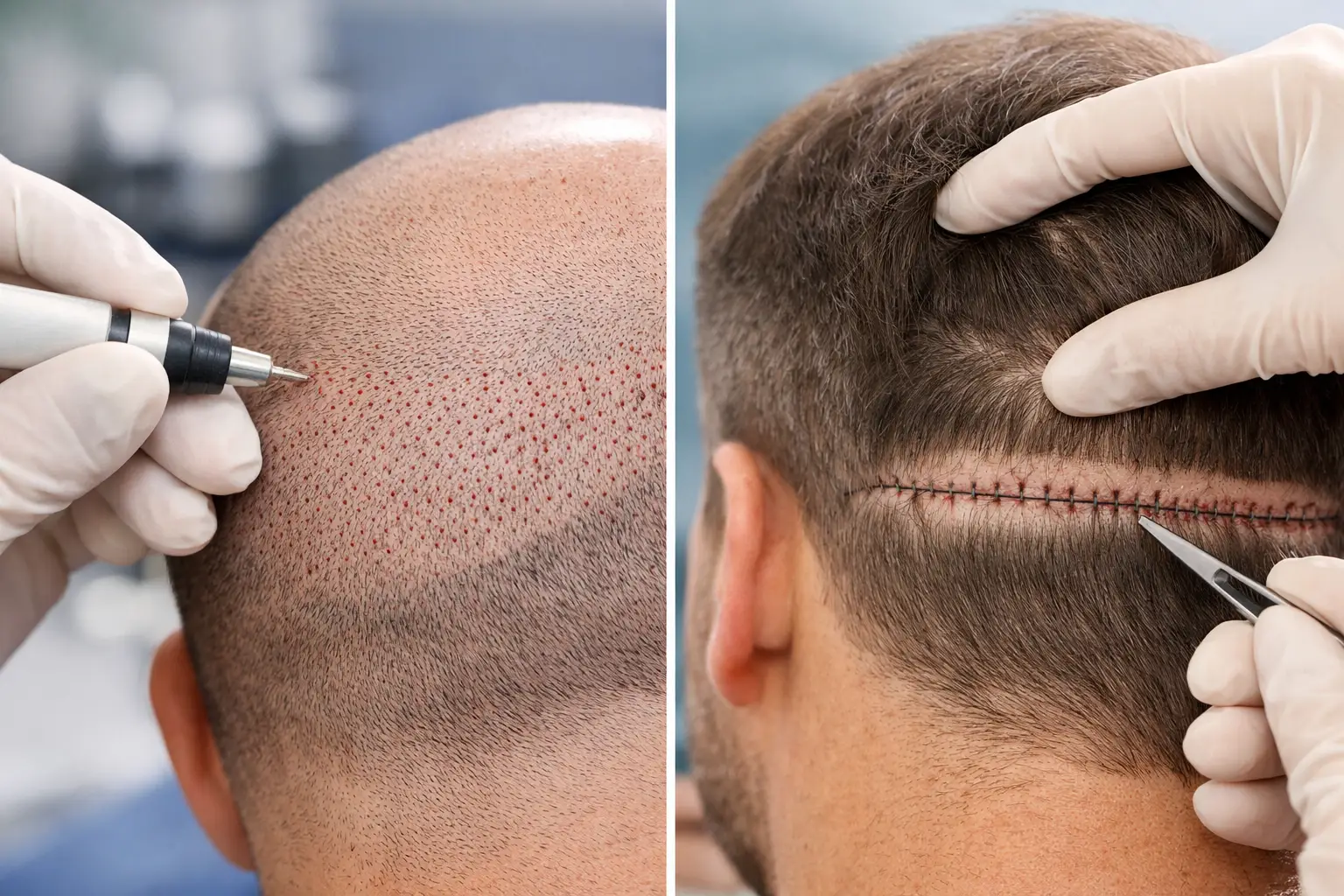
Follicular Unit Extraction, or FUE, removes individual follicular units from the donor area one at a time. Each unit may contain one to four hairs. The surgeon then prepares tiny recipient sites in the thinning area and places the grafts according to the desired hairline, density, and direction of growth.
Follicular Unit Transplantation, or FUT, is often called the strip method. A narrow strip of scalp is removed from the donor region, and the surgical team carefully separates it into individual follicular-unit grafts under magnification. The donor area is then closed with sutures, leaving a linear scar that is usually concealed by surrounding hair.
The implantation stage is similar in both methods. The real distinction lies in donor harvesting. FUE creates many small circular extraction marks, while FUT creates one fine linear scar. Neither method is automatically superior. The better option depends on your scalp, your goals, and the expertise behind the treatment plan.
Why scar placement matters more than scar-free claims
No hair transplant is completely scar-free. A responsible consultation should make that clear from the start.
With FUE, the small extraction marks generally heal as tiny pale dots spread across the donor zone. They can be difficult to notice when the procedure is performed thoughtfully and the hair is kept at a suitable length. However, very closely shaved hairstyles may reveal them, particularly after a large number of grafts or repeated procedures.
With FUT, the donor scar is a line rather than scattered dots. For many people, it remains well hidden beneath medium-length or longer hair. A patient who prefers a very short fade or fully shaved look may find this scar harder to conceal.
Scar appearance also varies from person to person. Skin type, healing tendencies, scalp tightness, surgical technique, and aftercare all play a role. This is why choosing a transplant method based on a single promise about invisible scarring can lead to disappointment. A better question is: how do you plan to wear your hair now and in the future?
Recovery: FUE may feel easier, but both need planning
FUE is often associated with a faster and more comfortable recovery because it does not involve a linear incision. Many patients return to desk-based work within a few days, although redness, swelling, and tiny scabs in both the donor and recipient areas are expected early on. Strenuous exercise, heavy sweating, swimming, and direct sun exposure should be avoided for the period advised by the treatment team.
FUT recovery can require more caution because the donor incision needs time to heal. There may be tightness or discomfort at the back of the scalp, and sutures are usually removed after about 10 to 14 days, depending on the closure method and healing progress. Patients should avoid activities that pull or strain the scalp during this period.
Neither option provides an overnight transformation. Transplanted hairs commonly shed within the first few weeks, which is a normal part of the growth cycle. New growth often begins around three to four months, becomes more noticeable between six and nine months, and continues to mature for up to 12 to 18 months. Patience is part of the process, regardless of the harvesting technique.
Graft yield and coverage: when FUT may have an advantage
For patients who need a high number of grafts to address extensive thinning, FUT can be an efficient choice. Because follicles are harvested from a strip of scalp, the surgeon may be able to obtain a substantial graft count while preserving more of the surrounding donor area for future use.
That does not mean FUE cannot treat larger areas. Advanced FUE can provide excellent graft numbers in suitable candidates. Still, extracting too many grafts across the donor area can create visible thinning if it is not carefully planned. Donor hair is finite, so long-term strategy matters as much as the immediate result.
This becomes especially relevant for younger patients with progressive pattern hair loss. A low, dense hairline can look appealing at first, but it may not remain balanced if hair loss continues behind it. A skilled assessment considers your age, family history, current pattern of loss, donor density, hair caliber, and the possibility that you may need more treatment later.
Who may be a better candidate for FUE?
FUE is often appealing to people who prefer to avoid a linear scar and want the flexibility to keep their hair relatively short. It can also be useful for patients with good donor density who need a modest to moderate number of grafts, or for those who have scalp tightness that makes strip harvesting less suitable.
It may be preferred for people who have already had a FUT procedure and want to use remaining donor hair without extending the existing linear scar. FUE can also harvest body hair in select cases, though scalp hair remains the preferred source for most restoration plans because it behaves more predictably.
FUE requires careful donor management. It is not just a matter of collecting as many grafts as possible. Strategic spacing, correct extraction angles, and protection of nearby follicles help preserve a natural donor appearance.
Who may be a better candidate for FUT?
FUT may suit someone with significant hair loss who needs a larger graft session and normally wears their hair long enough to cover a linear scar. It can also be appropriate when preserving the broader donor region is a priority for potential future procedures.
Patients with high donor density and good scalp laxity may be strong candidates. In the right hands, FUT can produce a high-quality graft yield with minimal follicle damage. The trade-off is accepting the linear scar and a recovery period that may be less convenient for people with active jobs, regular gym routines, or short-hair preferences.
A prior FUE procedure does not rule out FUT, either. Some patients benefit from a combined long-term strategy, especially when donor reserves need to be used thoughtfully over several sessions.
Cost should reflect planning, not just graft numbers
Hair transplant pricing is often discussed per graft, but that figure alone does not tell the whole story. The cost can reflect the complexity of hairline design, the number of grafts, the team’s experience, the technology used, the time required, and the level of clinical oversight.
A lower quote may be tempting, especially for a procedure that can involve thousands of grafts. Yet poorly planned harvesting can permanently compromise the donor area, while an unnatural hairline can be difficult and costly to correct. The goal is not to use the greatest possible number of grafts. It is to use the right number in the right places for a result that still looks convincing as you age.
The consultation should look beyond surgery
Not every person experiencing thinning needs a transplant right away. If hair loss is still active, stabilizing it first may help protect both existing hair and a future transplant result. Depending on the cause and pattern of loss, this may involve medical evaluation, low-level laser therapy, scalp treatments, or non-surgical options that create immediate cosmetic density.
For diffuse thinning, medical hair loss, or limited donor supply, non-surgical hair replacement and scalp micropigmentation may offer a more appropriate path. These options can also complement a transplant by improving the look of density while transplanted hair grows.
At HairSpec, a personalized scalp assessment can help clarify whether FUE, FUT, a non-surgical solution, or a staged approach best matches your condition and expectations. The most reassuring treatment plan is one that explains not only what can be achieved now, but how your hair can continue to look natural in the years ahead.
The best transplant technique is the one that respects your donor hair, supports your preferred lifestyle, and gives you confidence in the mirror without asking you to hide the way you chose to get there.