

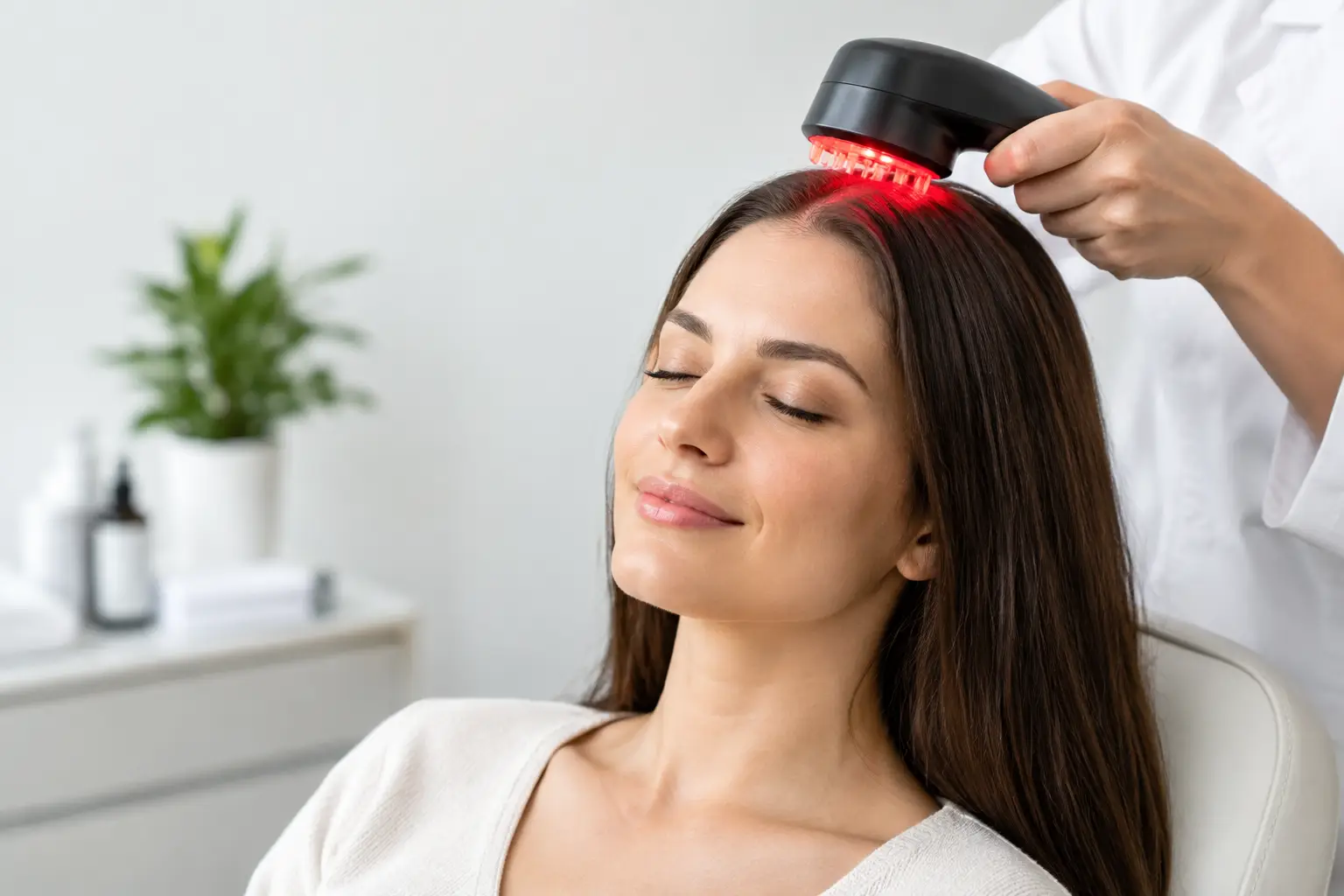
Seeing more scalp under bright office lighting, or noticing that your part has widened in photos, can make hair loss feel suddenly urgent. This laser hair therapy guide explains what low-level laser therapy can realistically do, who it may suit, and why a proper scalp assessment should come before committing to any treatment plan.
What Is Laser Hair Therapy?
Laser hair therapy, also called low-level laser therapy or LLLT, uses specific wavelengths of red light to stimulate activity around hair follicles. It is a non-invasive treatment, meaning it does not involve surgery, needles, or downtime. Depending on the system used, the light may be delivered through a laser cap, helmet, comb, or in-clinic device.
The goal is not to create an overnight transformation. Low-level laser therapy is designed to support follicles that are still active but producing thinner, weaker hairs. By encouraging cellular activity and circulation in the scalp, it may help improve hair quality, reduce shedding for some people, and support fuller-looking growth over time.
This distinction matters. A follicle that has been inactive for years may not respond in the same way as one that has only recently begun to miniaturize. That is why laser therapy works best as part of a personalized hair loss strategy rather than a one-size-fits-all promise.
How Low-Level Laser Therapy May Support Hair Growth
Hair grows in cycles. During the active growth phase, known as anagen, follicles produce hair fibers. In pattern hair loss, follicles can gradually shrink, shortening the growth phase and producing finer hairs until the scalp becomes more visible.
Laser therapy is thought to encourage energy production within follicle cells and support a healthier scalp environment. For the right candidate, that can help existing follicles function more effectively. Results may include less visible thinning, stronger-feeling hair, and improved density in areas where follicles remain viable.
It is not a cure for every cause of hair loss. Genetic pattern baldness, stress-related shedding, hormonal changes, nutritional issues, autoimmune conditions, medication effects, and scalp disorders can look similar at first glance but require different approaches. Treating without identifying the likely cause can waste time and delay more appropriate care.
What treatment feels like
Most people find laser hair therapy comfortable and easy to fit into a routine. There is no anesthesia, recovery period, or visible sign that you have had a session. In-clinic treatments are typically relaxing, while home-use devices offer convenience for people with demanding schedules.
Consistency is the trade-off. A device that is used irregularly is unlikely to deliver meaningful change. Your specialist can recommend a schedule based on the device, your level of thinning, and whether laser therapy is being combined with other treatments.
Who Is a Good Candidate for Laser Hair Therapy?
Low-level laser therapy is often most appropriate for men and women with early to moderate thinning, especially when hair is becoming finer around the hairline, crown, or part line. It can also appeal to people who want a gentle, non-surgical starting point before considering more intensive options.
You may be a suitable candidate if you still have visible hair in the area of concern, have noticed progressive thinning, and are prepared to follow a consistent treatment schedule for several months. People who want to support the results of other hair restoration treatments may also consider it as part of a broader plan.
However, it may not be the right standalone choice for everyone. A completely smooth bald area has fewer active follicles for the treatment to support. Significant scarring, active scalp inflammation, or sudden patchy hair loss should be assessed carefully before beginning any cosmetic hair treatment. If hair loss is rapid, painful, accompanied by itching or scaling, or linked to illness or medication, medical evaluation is especially important.
For clients in Singapore, a private scalp assessment can help distinguish between cosmetic density concerns and hair loss that needs a more targeted pathway. The best recommendation should reflect your scalp condition, lifestyle, expectations, and comfort level.
What Results Can You Expect and When?
Patience is essential. Hair growth moves slowly, and it takes time for a supported follicle to produce a longer, visibly thicker strand. Some people notice reduced shedding or improved hair texture first. More noticeable changes in density often take several months of regular use.
A realistic timeline is usually measured in months, not weeks. Your starting point matters as well. Someone with recent diffuse thinning may see a different response from someone with long-standing hereditary hair loss. Clear before-and-after photographs taken under the same lighting are more useful than checking the mirror every day.
Results are also easier to preserve than rebuild. When laser therapy is helping, stopping treatment may allow the underlying hair loss pattern to continue. Your specialist should explain the maintenance commitment before you start, so there are no surprises later.
Laser Hair Therapy Guide: Choosing the Right Plan
The best laser hair therapy plan starts with the right questions: What type of hair loss is present? How long has it been progressing? Are the follicles likely to be responsive? What result would make a meaningful difference to you?
A detailed consultation should include an examination of the scalp and hair density, a discussion of medical and family history, and a realistic conversation about timelines. It should also cover other available options when laser therapy alone is unlikely to meet your goals.
For example, low-level laser therapy may be paired with scalp-focused restorative treatments for people with active thinning. If the main concern is the appearance of visible scalp rather than follicle stimulation, scalp micropigmentation can create the look of greater density. For advanced hair loss, a natural-looking non-surgical hair replacement solution may provide an immediate cosmetic result while other treatment decisions are considered.
This is where a full-spectrum hair specialist has an advantage. The recommendation does not need to be limited to the one treatment a provider happens to offer. At HairSpec, the focus is on matching the solution to the person, whether that means supporting natural hair, enhancing the look of density, or exploring a more advanced restoration route.
Questions to Ask Before Starting
Before investing in laser therapy, ask what device will be used, how often treatment is recommended, and how progress will be monitored. Ask whether your scalp and pattern of hair loss make you a strong candidate, not simply an eligible one.
You should also understand the full cost of ongoing care and what happens if your results plateau. A responsible provider will explain that response varies and will not present laser therapy as a guaranteed replacement for every form of hair restoration.
If you are using prescription hair loss medication, have a history of skin sensitivity, or are undergoing treatment for a medical condition, share that information during your consultation. Laser therapy is generally well tolerated, but your care plan should always take your individual circumstances into account.
A Confidence-First Approach to Thinning Hair
Hair loss decisions can feel personal because they are personal. The right treatment is not necessarily the most aggressive one, the newest device, or the option that worked for someone else. It is the approach that fits your hair condition, your desired outcome, and the level of maintenance you can realistically sustain.
A professional scalp assessment gives you a clearer starting point than guesswork. Whether laser hair therapy becomes your first step or one part of a wider plan, informed care can help you move forward with more confidence and a solution built around the hair you want to see.