

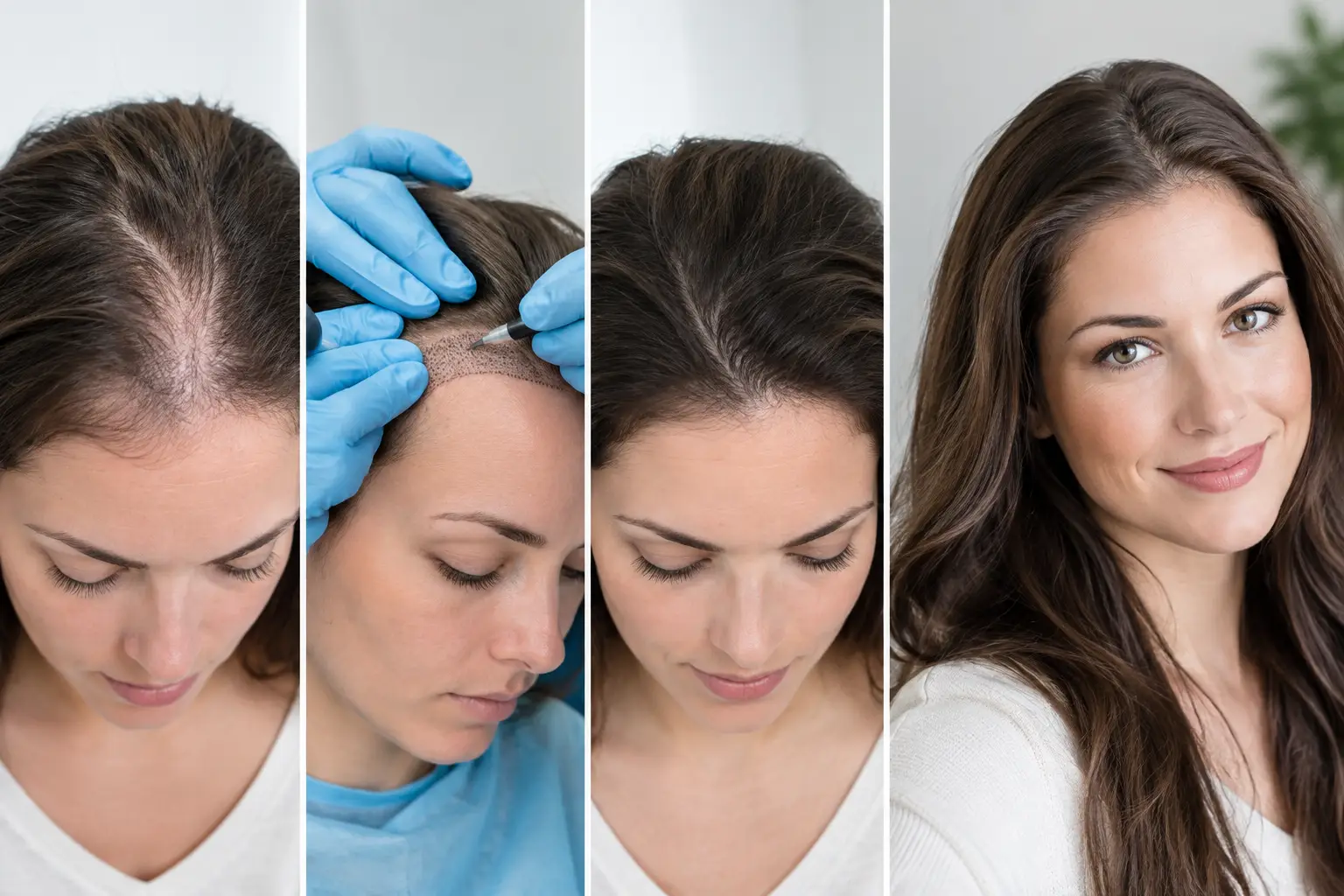
A female hairline restoration story rarely starts with a dramatic moment in the mirror. More often, it begins with small adjustments: changing a parting, avoiding tight ponytails, stepping away from bright overhead lighting, or spending extra time arranging the front of the hair before work. For many women, a receding or thinning hairline is not simply a cosmetic concern. It can change how freely they style their hair, show up in photos, and feel in everyday interactions.
Hairline restoration is not one treatment or one look. The right approach depends on why the hairline has changed, how quickly it is progressing, the condition of the scalp, and whether the goal is to improve density, soften the shape, disguise visible scalp, or pursue lasting surgical restoration. A thoughtful plan should begin with those details, not a preset package.
When the Hairline Became Hard to Ignore
Consider a typical client we will call Maya. She had always worn her hair swept back for the office and tied it up for exercise. In her late 30s, she noticed more scalp showing at both temples. At first, she assumed it was a temporary response to stress. Months later, the areas appeared wider, especially in photographs taken from above.
Maya had not lost all of her hair. That was part of what made the concern difficult to explain to friends and family. Her overall hair still looked healthy from a distance, but the finer strands around the front no longer provided the same coverage. She began using fibers and carefully placed styling products, which helped for special occasions but felt unreliable in humid weather and after a workout.
This experience is common. Female hairline changes can be subtle and diffuse rather than following the more recognizable patterns often associated with male hair loss. Some women see gradual temple recession. Others experience breakage and thinning along the edges, a widening part, or reduced density across the frontal scalp.
Why female hairlines can change
The cause matters because it influences which restoration options make sense. Hormonal shifts, hereditary thinning, stress-related shedding, nutritional factors, certain medical conditions, medication, and scalp inflammation can all affect density. Repeated tension from braids, extensions, tight buns, or sleek ponytails may also contribute to traction alopecia, particularly around the temples and edges.
A cosmetic solution can create an immediate improvement, but it should not replace proper attention to a possible underlying condition. If shedding is sudden, accompanied by itching or scaling, or linked to changes in health, a medical evaluation may be appropriate alongside a hair restoration consultation.
The Assessment Changed the Conversation
Maya expected to be told she needed a transplant. Instead, her consultation started with questions: When did she first notice the thinning? Was she shedding actively? How often did she wear tension-heavy styles? Did she want a result she could change over time, or was she considering a more permanent option?
A professional scalp assessment looks beyond the visible gap at the hairline. It considers the quality and density of existing hair, scalp condition, the pattern of loss, the stability of the donor area when transplantation is being considered, and the client’s lifestyle. For someone who frequently swims, exercises, or changes hair color and style, practical maintenance considerations matter as much as the visual result.
The most reassuring part of a consultation is often learning that there are multiple pathways. A woman does not need to commit immediately to surgery, nor should she be pushed toward a temporary option if she is a suitable candidate for a more lasting procedure. The goal is a natural-looking hairline that fits her features and feels manageable in real life.
Choosing a Restoration Path
For Maya, the assessment showed early frontal thinning rather than a completely bare hairline. Because she wanted an immediate, non-surgical change while monitoring her natural growth, she chose a customized non-surgical hair replacement solution designed to blend with her existing hair. The piece added density at the front without forcing her to abandon the length and style she already liked.
For other women, a different plan may be more appropriate. A hair transplant can be considered when hair loss is stable, donor hair is adequate, and the client wants to rebuild the hairline with her own growing hair. The design requires particular care. A female hairline should not look too low, too straight, or too dense at the front. Natural hairlines have gentle irregularity, soft transitions, and proportions that complement the face.
Scalp micropigmentation can be helpful when the main concern is contrast between hair and scalp. Rather than creating hair, it uses precisely placed pigment to reduce the appearance of visible scalp and create an impression of density. It can work on its own in selected cases or alongside other restoration methods.
When existing follicles are still present but weakened, low-level laser therapy, mesotherapy, and supportive scalp care may be discussed as part of a broader plan. These options are not instant replacements for lost density, and results vary by person and cause. Their role is often to support scalp health and existing hair while a client uses a cosmetic or restorative solution for immediate coverage.
For women with medical hair loss, extensive thinning, or a need for flexibility, a high-quality medical wig or customized wig can offer a polished result without placing further stress on fragile hair. The best choice is the one that matches the individual’s needs, not the treatment that sounds most advanced.
What natural results actually require
Natural-looking hairline restoration is built on details that are easy to overlook. The color should blend across the root area, not just match the ends. The density must be realistic for the client’s age and natural hair texture. The front should be shaped to allow softness around the face rather than creating an obvious line.
It also requires an honest discussion about maintenance. Non-surgical systems, wigs, and extensions require fitting, care, and periodic servicing. Transplants involve healing time and patience while new growth develops. Scalp micropigmentation may need future touch-ups. There is no universally maintenance-free answer, but there are options that make maintenance feel simple and worthwhile for the right person.
The Moment She Wore Her Hair Up Again
After Maya’s fitting, the immediate change was visible, but her reaction was quieter than she expected. She did not want a hairline that made her look like someone else. She wanted to stop thinking about the front of her hair every time she saw a reflection.
Over the following weeks, she returned for adjustments so the fit, blending, and styling felt right. She learned which products worked best, how to care for the solution, and how to keep her remaining hair and scalp comfortable. She also began a supportive treatment plan for her natural hair, with the understanding that any future changes would be reviewed rather than guessed at.
The meaningful milestone came when she wore a low ponytail to a weekend brunch without checking the temples in every reflective surface. That is often what successful female hairline restoration looks like: not a dramatic transformation for other people to judge, but a return to choices that had quietly disappeared.
A Plan That Respects Your Comfort and Goals
Women exploring hairline restoration deserve privacy, clear information, and options that reflect both their appearance goals and their scalp health. A good specialist will explain what each route can realistically achieve, where the limitations are, and how the result may need to evolve if hair loss continues.
At HairSpec, a private scalp assessment can help clarify whether non-surgical hair replacement, scalp micropigmentation, supportive therapies, a wig solution, or hair transplant planning may fit your needs. The right next step is not necessarily the most permanent or the most visible. It is the one that helps you feel comfortable facing the mirror, the camera, and your day with less effort.