

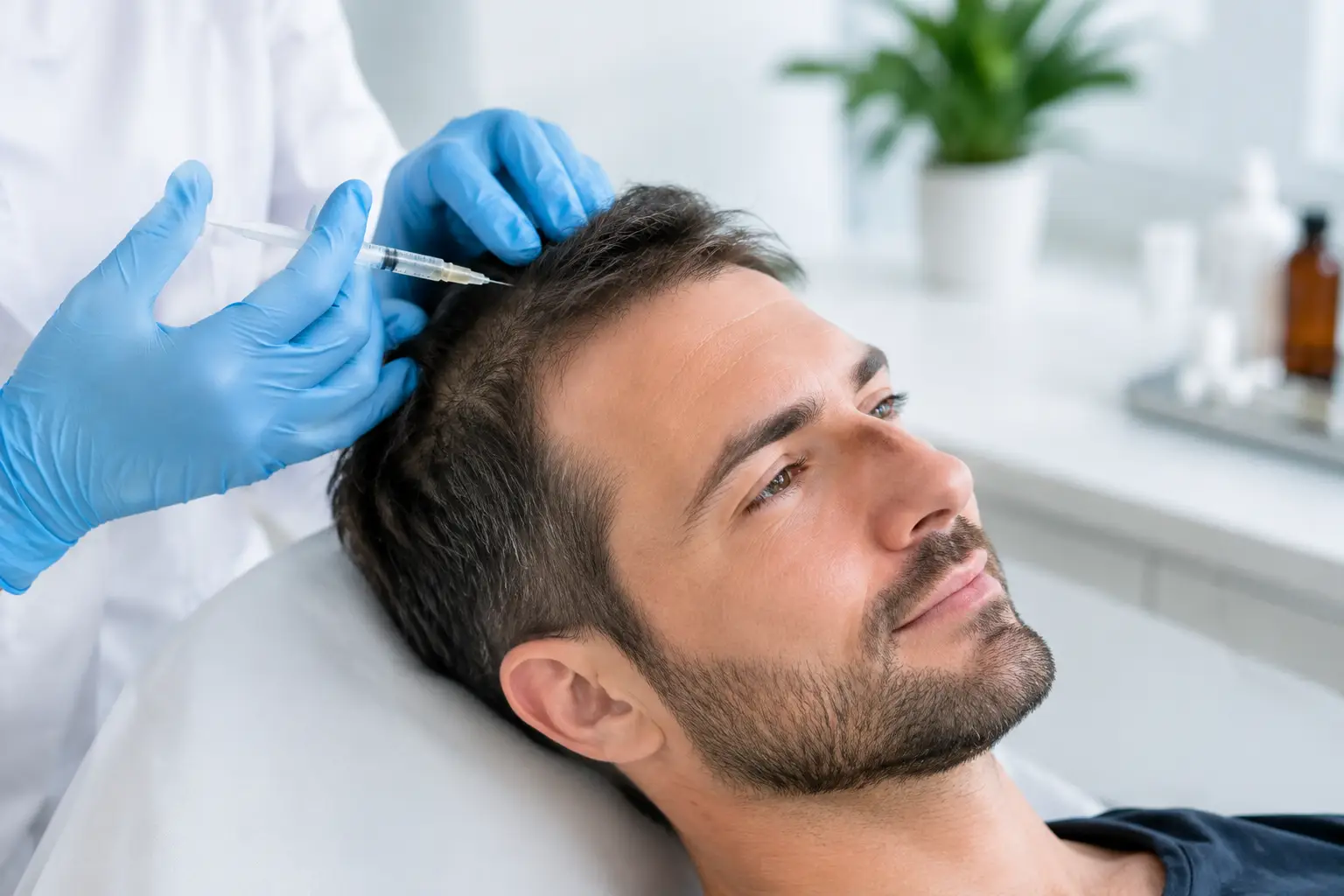
Hair thinning often feels more urgent when you can see extra scalp under office lighting or notice your part widening in photos. A guide to hair loss mesotherapy can help you understand whether this injection-based treatment is a sensible next step – and whether it matches the cause, stage, and pattern of your hair loss.
Mesotherapy is not a replacement for a proper diagnosis. It is a scalp-focused treatment that may support hair quality, reduce shedding for suitable candidates, and complement a broader restoration plan. The best outcomes come from matching the treatment to your individual scalp condition rather than relying on a single procedure to solve every type of hair loss.
What Is Hair Loss Mesotherapy?
Hair mesotherapy involves a series of very small injections placed into the scalp. The injections deliver selected active ingredients into the skin layer around the hair follicles. Depending on the provider and treatment plan, these may include vitamins, minerals, amino acids, peptides, hyaluronic acid, or other scalp-supporting compounds.
The goal is to create a healthier environment around follicles that are still active but producing finer, weaker hairs. Some protocols may also use prescription ingredients, while others focus on nutrient and regenerative formulations. This variation matters. Mesotherapy is not one standardized formula, so you should know what is being injected, why it has been selected, and what evidence supports its use for your concern.
The treatment is commonly considered by men and women with early thinning, increased shedding, or hair that has become less dense and less resilient. It may be used as part of a plan that also includes low-level laser therapy, topical treatments, scalp care, or hair replacement options for more immediate cosmetic coverage.
How Hair Loss Mesotherapy Is Intended to Help
Hair follicles need an adequate blood supply, a balanced scalp environment, and time in the active growth phase to produce stronger strands. Mesotherapy is designed to support these conditions locally. By placing ingredients directly into the scalp, treatment aims to improve hydration and nourishment around the follicles while supporting scalp circulation and hair quality.
For someone with early-stage androgenetic hair loss, also known as pattern hair loss, the practical goal is usually to slow visible progression and help existing hair look thicker over time. For someone recovering from stress-related shedding or a period of poor scalp health, the focus may be reducing shedding and encouraging healthier regrowth.
Results depend on whether follicles remain viable. If an area has been smooth and bald for years, there may be too few functioning follicles for mesotherapy to make a visible difference. In that situation, scalp micropigmentation, a hair system, or hair transplant planning may be more appropriate than repeated injections.
Who May Be a Good Candidate?
Mesotherapy is usually best suited to people with diffuse thinning, early pattern hair loss, or hair that is becoming finer without complete bald patches. It can appeal to those who prefer a non-surgical option and want a treatment with little downtime. It may also be useful for clients who want to support their natural hair while using a non-surgical hair replacement solution for added density.
A scalp assessment should come first. Hair loss can be related to genetics, hormonal changes, illness, nutritional deficiencies, medication, traction from tight styling, inflammatory scalp conditions, or autoimmune disorders. These causes do not all respond to the same approach.
Mesotherapy may not be the right starting point if you have an active scalp infection, unexplained patchy hair loss, uncontrolled skin inflammation, a bleeding disorder, or a known allergy to ingredients in the treatment. Pregnancy, breastfeeding, and certain medical conditions can also affect suitability. Be open about your health history and current medications before proceeding.
What Happens During a Mesotherapy Appointment?
A treatment session typically begins with a review of your scalp, hair density, shedding pattern, and goals. Photographs or scalp imaging can be helpful because hair changes gradually, and a reliable baseline makes progress easier to assess.
The scalp is cleansed, and a topical numbing product may be used if needed. A specialist then performs a series of shallow injections across the areas of concern. The appointment is generally brief, although the exact duration depends on the size of the treatment area and the protocol being used.
Most people describe the sensation as small, quick pinches or pressure. There may be temporary redness, tenderness, tiny raised points, or mild bruising afterward. These effects usually settle within a short period. Your provider may ask you to avoid washing your hair, intense exercise, swimming, or heat exposure for a defined period after treatment so the scalp can recover comfortably.
How Many Sessions Will You Need?
Mesotherapy is typically delivered as a course rather than a one-time appointment. A common plan may involve several sessions spaced one to a few weeks apart, followed by maintenance sessions if you and your specialist decide the treatment is helping. The schedule should be tailored to your hair loss pattern, the formula used, and your response over time.
Hair grows slowly, so patience is essential. Some clients first notice less shedding or improved hair texture. Changes in visible density, when they occur, generally take several months because new growth must emerge and gain length. Results are rarely immediate, and a responsible provider should not promise a full head of hair from injections alone.
Progress should be reviewed after an agreed period. If there is no meaningful improvement, it may be time to adjust the plan rather than continue indefinitely. This is where a specialist with multiple treatment pathways can offer more value than a single-service provider.
A Guide to Hair Loss Mesotherapy: Benefits and Limits
The main advantage of mesotherapy is that it is minimally invasive and focused directly on the scalp. There is no surgical incision, and most people return to normal routines quickly. It can be an approachable option for people who are not ready for transplant surgery or who want to preserve and strengthen their existing hair.
Its limits deserve equal attention. Research on mesotherapy for hair loss is still mixed because injection formulas, techniques, treatment intervals, and patient groups vary widely. A positive response in one person does not guarantee the same response in another. It should be viewed as a supportive treatment, not a cure for every form of thinning.
Cost is another practical consideration. Because treatment generally requires multiple sessions and possible maintenance, ask for a clear plan and discuss how success will be measured. Better hair quality, reduced shedding, improved density in photographs, and greater confidence can all be meaningful outcomes, but expectations should remain realistic.
Mesotherapy Compared With Other Hair Loss Options
Mesotherapy can be useful on its own for selected cases, but combination care is often more effective. For genetic pattern hair loss, medically appropriate treatments such as topical minoxidil or prescription medication may be discussed with a qualified medical professional. These options can have side effects and are not suitable for everyone, which is why personal guidance matters.
Low-level laser therapy is another non-invasive option that may support follicle activity over time. It requires consistency and is often considered for diffuse thinning or early hair loss. Hair transplants are more suitable when there is sufficient donor hair and a person wants a permanent surgical redistribution of follicles, though they involve recovery time and careful planning.
For immediate visual improvement, non-surgical hair replacement, wigs, toupees, hair weaving, extensions, and scalp micropigmentation can create the appearance of fuller hair without waiting for biological regrowth. These approaches are not lesser alternatives. For many people, they are the most direct route to a natural-looking result and renewed confidence.
Choosing a Provider With Care
The quality of assessment matters as much as the procedure itself. Ask what is in the formula, how the provider evaluates candidacy, how they manage hygiene and aftercare, and what alternatives they would recommend if mesotherapy is not the strongest fit. You should never feel pressured into a treatment course before you understand its expected benefits and limitations.
A private consultation can also make it easier to discuss the emotional side of hair loss. At HairSpec, a scalp assessment is used to look beyond the visible thinning and guide clients toward a personalized combination of restorative, aesthetic, or replacement solutions.
Hair loss is personal, but the next step does not have to be uncertain. The most helpful plan is one that respects your health, timeline, budget, and the result you want to see when you look in the mirror.