

A hair transplant is no longer simply a matter of moving hair from one area to another. The most meaningful hair transplant technology advances now affect nearly every stage of treatment: assessing the donor area, designing a realistic hairline, extracting delicate grafts, placing them precisely, and supporting recovery. For people who want a fuller, natural-looking result, that progress can be reassuring. It also makes one thing clear: technology is only as valuable as the specialist using it and the plan built around your hair loss.
Why technology matters in a hair transplant
A successful transplant has two priorities that must work together. The first is graft survival. Each follicular unit is living tissue, so it needs careful extraction, handling, storage, and implantation. The second is appearance. Hair must be placed at the right angle, direction, density, and distribution to suit the face, existing hair, and likely future pattern of thinning.
Modern tools can improve consistency and reduce unnecessary trauma during these steps. They cannot create an unlimited donor supply, stop progressive hair loss on their own, or guarantee a certain density. That is why an experienced assessment still matters before choosing any surgical option.
For many people, especially those with early thinning or diffuse hair loss, a transplant may not be the first or only answer. Non-surgical hair replacement, scalp micropigmentation, laser-based therapies, and medical or restorative approaches can play an important role depending on the cause of hair loss and the result you want to achieve.
Hair transplant technology advances in assessment and planning
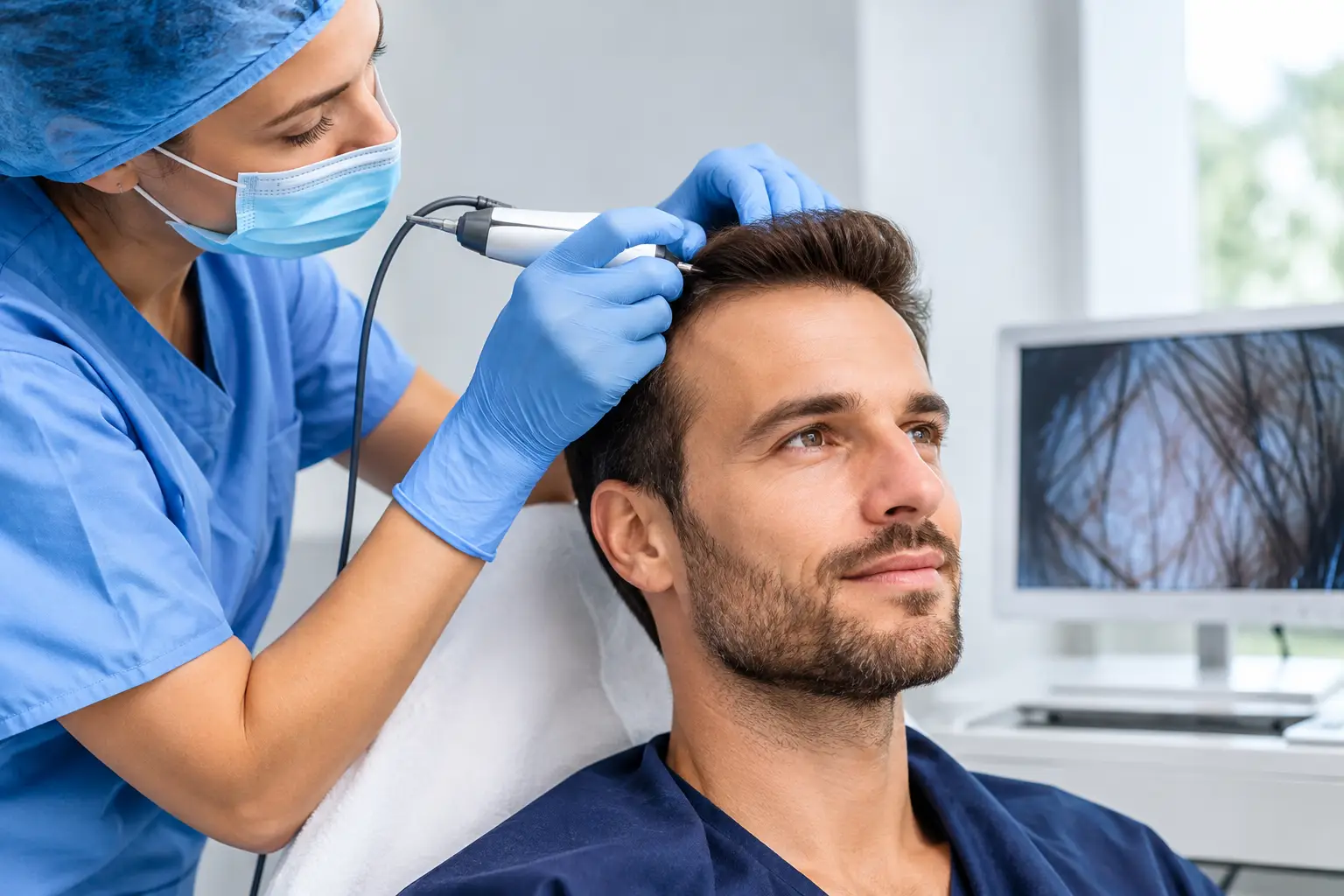
The strongest transplant plans begin before a single graft is removed. High-resolution scalp imaging and digital magnification allow specialists to examine hair density, follicle grouping, shaft diameter, and signs of miniaturization in both the donor and recipient areas. This helps determine whether the donor area is stable enough for harvesting and how many grafts can be taken conservatively.
Digital hair and scalp analysis can also reveal a common issue that is easy to miss in a casual consultation: existing hairs in the thinning area may continue to weaken over time. If a hairline is designed too low or a crown is packed too aggressively without considering future loss, the result may look unnatural later. Good planning protects donor reserves for the future rather than using everything available in one session.
Hairline design is more precise, but should still look soft
Software-assisted visualization and photographic planning can help patients understand proposed hairline shape and density. This can be useful, particularly for someone who has spent years avoiding mirrors or styling around thinning areas. But a digital preview is not a promise of an identical final result.
A natural hairline requires more than symmetry. It should reflect facial proportions, age, gender expression, hair characteristics, and the way a person may lose hair in the years ahead. The leading edge also needs irregularity. Real hairlines are not ruler-straight rows of evenly spaced hairs. Technology helps with planning, but artistry and clinical judgment create the believable result.
More refined FUE extraction and graft handling
Follicular unit extraction, or FUE, has become one of the most recognized modern transplant methods. Rather than removing a strip of scalp, FUE harvests individual follicular units from the donor area using tiny punches. This can leave small dot-like scars that are usually less noticeable than a linear scar, particularly when the hair is kept short.
Advances in punch design, motor control, magnification, and extraction technique aim to reduce transection, which occurs when a follicle is accidentally damaged during removal. Hair follicles do not all grow at the same angle beneath the scalp, so the procedure requires careful adjustment for each donor area. A tool that is too aggressive, too fast, or used without proper technique can compromise graft quality.
Once removed, grafts must be sorted and protected. Temperature-controlled storage solutions and careful hydration can help preserve them during the procedure. Teams may organize grafts by the number of hairs in each follicular unit, reserving finer single-hair grafts for a soft hairline and using multi-hair grafts to build coverage behind it.
This is a part of the procedure patients rarely see, yet it has a direct impact on growth. Faster extraction is not automatically better if it means grafts are handled roughly or the donor area is overharvested.
Robotic assistance: useful in selected cases
Robotic systems can assist with mapping and extracting follicular units during FUE. They may provide useful precision and speed for suitable donor areas, particularly when hair is straight and the scalp characteristics are favorable. Some clinics also use advanced imaging to help identify and track follicular units.
However, robotic assistance is not a replacement for a skilled surgeon and trained clinical team. Curly or tightly curled hair, variable follicle angles, scarring, and limited donor density can require a more tailored approach. A patient should not choose a clinic solely because it has a particular device. The better question is how the team uses its technology to protect grafts, preserve the donor area, and design for long-term appearance.
Implantation tools support natural direction and density
After grafts are harvested, the recipient area must be prepared and implanted with exceptional care. Modern implanter pens and refined recipient-site instruments allow clinicians to place grafts into very small channels while controlling depth, angle, and direction.
This matters because transplanted hair needs to follow the way native hair grows. At the temples, hair often lies flatter. In the crown, it follows a spiral pattern. At the front, the transition from skin to hair should be gradual rather than dense and abrupt. Precise placement can create a more natural visual density without using more grafts than the donor area can safely provide.
Some methods place grafts directly with implanter devices, while others create recipient sites first and then place the grafts. Neither approach is universally superior. The right technique depends on the treatment area, hair characteristics, graft count, and the experience of the clinical team. What matters most is careful graft handling and a placement plan that respects blood supply and existing hairs.
Better recovery support, not instant results
Recovery protocols have also become more structured. Clinics can provide clearer aftercare guidance, gentle cleansing instructions, follow-up monitoring, and strategies to minimize disruption to newly placed grafts. In selected cases, supportive treatments such as platelet-rich plasma may be discussed as part of a broader recovery or hair health plan, although results can vary and it should not be presented as a guaranteed growth booster.
Low-level laser therapy is another non-invasive option that may be considered for people managing ongoing thinning around transplanted hair. It does not replace a transplant, but it may fit into a longer-term plan intended to support existing hair. The right combination depends on diagnosis, expectations, medical history, and willingness to maintain treatment.
It is also essential to understand the transplant timeline. The transplanted shafts often shed in the weeks after surgery. New growth commonly begins gradually over several months, with fuller maturation taking up to 12 months or longer. Technology can improve the process, but it does not remove the need for patience.
Choosing technology without being sold a gadget
When comparing providers, ask how they evaluate donor capacity, whether they assess ongoing hair loss, and who performs each major step of the procedure. Ask how the hairline is designed, how grafts are stored and counted, and what follow-up care is included. Clear answers are more valuable than impressive device names.
A thorough consultation should also leave room for alternatives. A person seeking immediate cosmetic density for a special event may prefer non-surgical hair replacement. Someone with a sparse donor area may benefit from scalp micropigmentation to create the appearance of a fuller hairline or closely cropped coverage. For medical hair loss, the priority may be a comfortable, natural-looking medical wig while the underlying condition is addressed.
At HairSpec, a personalized scalp assessment can help place transplant technology in the broader context of your hair goals. The most advanced option is not always the right one. The right path is the one that protects your comfort, respects your donor hair, and gives you a result you can feel confident wearing every day.