

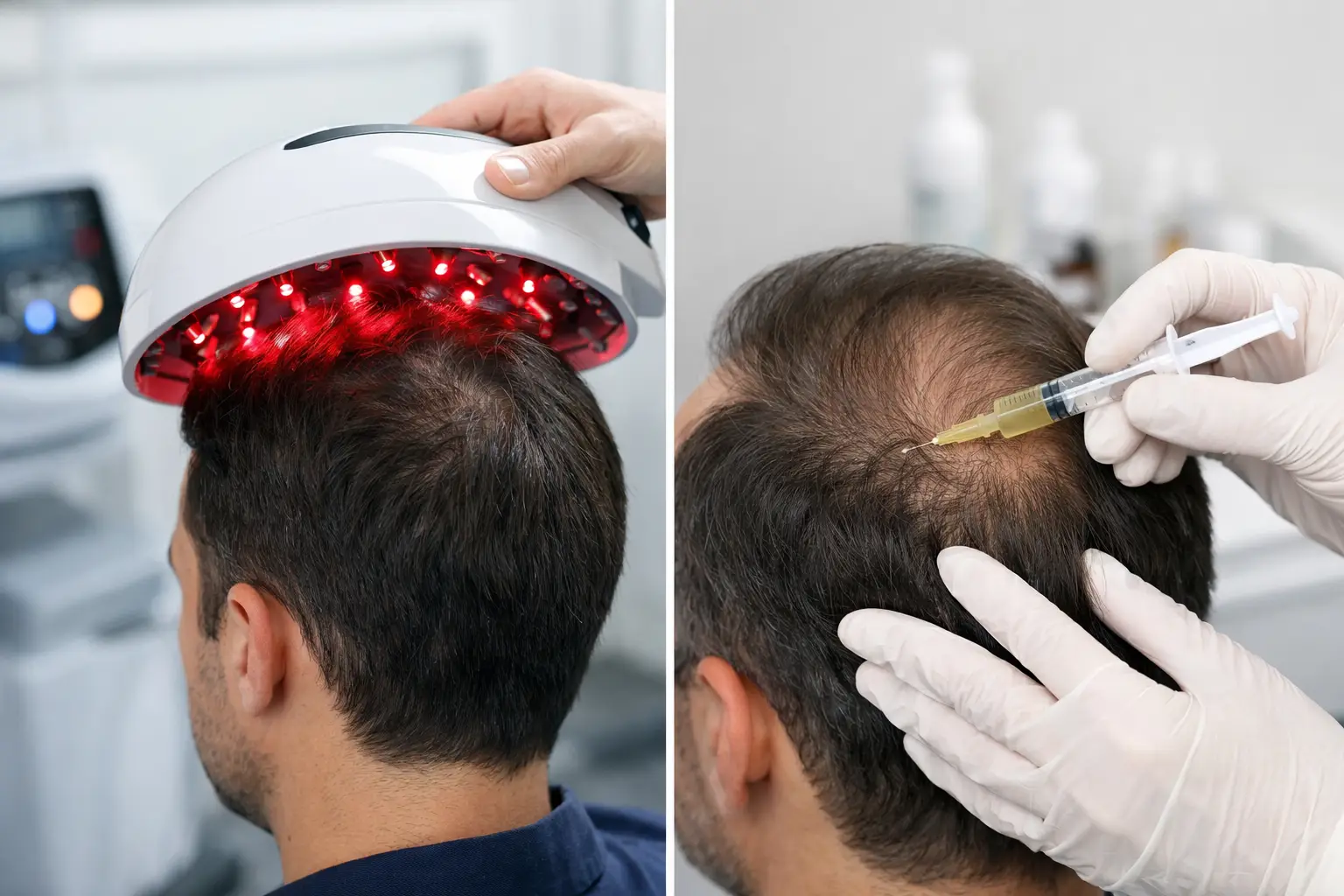
A widening part, more hair in the shower, or a scalp that shows through under office lighting can change how you feel long before others notice. When comparing laser therapy vs mesotherapy, the better choice is not simply the one that sounds more advanced. It is the one that suits your pattern of hair loss, scalp condition, comfort level, and willingness to commit to a treatment plan.
Both options are used to support healthier-looking, fuller hair without surgery. They work very differently, however. Low-level laser therapy uses light energy to stimulate the scalp, while mesotherapy delivers a customized blend of ingredients into the scalp through tiny injections. Understanding that difference can help you make a more confident decision.
Laser Therapy vs Mesotherapy: The Key Difference
Low-level laser therapy, sometimes called LLLT or red-light therapy, uses controlled low-level light to stimulate activity around the hair follicles. The goal is to support cellular energy, circulation, and the growth phase of the hair cycle. It is noninvasive, meaning there are no needles, incisions, or recovery downtime.
Mesotherapy is an injectable scalp treatment. A practitioner administers small amounts of selected ingredients into the skin layer near the follicles. Depending on the assessment and treatment approach, these formulas may include vitamins, amino acids, minerals, peptides, or other hair-supporting compounds. The objective is to deliver those ingredients locally rather than relying only on oral supplements or topical products.
In simple terms, laser therapy stimulates the scalp through light, while mesotherapy introduces active ingredients through micro-injections. Neither approach creates new follicles in a fully bald area. Both are generally most useful when follicles are still present but producing weaker, finer, or slower-growing hair.
What Low-Level Laser Therapy Feels Like
For many people, comfort is the deciding factor. Laser therapy is painless and typically feels like a quiet scalp session. There is no need for numbing cream, and most clients can return to work, exercise, or social plans immediately afterward.
Because results depend on cumulative stimulation, consistency matters. A single session will not transform density overnight. Most people need a regular course of treatments before assessing changes in shedding, hair quality, or visible coverage. Improvements, when they occur, tend to be gradual: less shedding first for some people, followed by stronger-looking strands and better overall fullness over several months.
Laser therapy may suit you if you are at the early stages of thinning, prefer a completely needle-free option, or want a treatment that can fit discreetly around a busy schedule. It can also be considered as part of a broader plan for pattern hair loss, provided the scalp assessment supports it.
What Mesotherapy Feels Like
Mesotherapy is more direct, but it is also more hands-on. The treatment involves multiple small injections across the areas of concern. Sensation varies from person to person. Some describe brief pinching or stinging, while others find the session very manageable, particularly when the provider uses techniques to improve comfort.
Mild tenderness, pinpoint redness, or small temporary bumps can occur after treatment. These usually settle quickly, but mesotherapy may not be ideal if you strongly dislike needles, have an active scalp infection, or have a medical condition that makes injectable treatments unsuitable. A qualified provider should review your health history, medications, allergies, and scalp condition before recommending it.
Mesotherapy is often considered by people who want targeted scalp support and are comfortable with a minimally invasive approach. Like laser therapy, it requires a course of appointments rather than a one-time treatment. Your provider may also recommend maintenance sessions based on your response and hair-loss pattern.
Which Treatment Delivers Faster Results?
Neither treatment should be marketed as an instant fix. Hair grows slowly, and the visible hair shaft reflects changes that began weeks or months earlier beneath the scalp. For that reason, realistic expectations are essential.
Mesotherapy can feel more immediate because active ingredients are delivered directly into the scalp during the appointment. Some clients report that their scalp and hair feel healthier after early sessions. Still, meaningful changes in shedding or density usually need time and repeated treatment.
Laser therapy also works progressively. Its advantage is that it can be easy to maintain because there is no discomfort or recovery period. It may be the more practical option for someone who wants a gentle, noninvasive routine they can sustain over the long term.
The response to either treatment depends on the cause of hair loss. Early androgenetic hair loss, stress-related shedding, nutritional concerns, and temporary scalp imbalance can each require a different strategy. If shedding is sudden, patchy, painful, or associated with scalp scaling, seek medical evaluation. Those signs may point to a condition that needs diagnosis before cosmetic or restorative treatment begins.
Choosing Based on Your Hair Loss Stage
For early thinning, laser therapy may be an appealing first step. It is comfortable, noninvasive, and designed to support follicles that are still active. It may also work well for those who want to protect existing density while exploring other options.
For ongoing thinning where a more targeted scalp treatment is appropriate, mesotherapy may be considered. It is not automatically stronger or better than laser therapy. It is simply a different method, with more intensive delivery and a different comfort profile.
For advanced hair loss, neither option alone may provide enough visible coverage if the follicles are no longer viable. In these cases, a specialist may discuss alternatives such as hair transplantation, scalp micropigmentation, medical wigs, or non-surgical hair replacement. These solutions serve different goals: some aim to support biological hair growth, while others create immediate visual density.
That distinction matters. A person seeking a fuller appearance for an upcoming event may benefit more from a cosmetic density solution than from a treatment that takes months to show change. Someone in the early stages of thinning may prefer a conservative plan focused on preserving and supporting their own hair.
Can Laser Therapy and Mesotherapy Be Combined?
In some cases, yes. A treatment plan may use laser therapy for ongoing scalp stimulation and mesotherapy for targeted support. Combining treatments should not be treated as a default package, however. More procedures do not always mean better outcomes.
The right approach depends on your scalp sensitivity, diagnosis, budget, available time, and treatment goals. A thoughtful plan should also account for home care, stress, styling habits, nutrition, and any prescribed medical treatments you are already using. Hair loss is often influenced by more than one factor, which is why one-size-fits-all recommendations tend to disappoint.
At HairSpec, a free scalp assessment can help clarify whether laser therapy, mesotherapy, or another personalized solution better fits your needs. A close look at the scalp and existing hair density helps set realistic expectations before you commit to a course of treatment.
Questions to Ask Before You Start
Before choosing either option, ask what type of hair loss you have and whether your follicles are likely to respond. Ask how many sessions are recommended, what the full treatment and maintenance schedule looks like, and what changes would count as a realistic result in your case.
It is also worth asking about comfort, aftercare, possible side effects, and whether the treatment can be used alongside medications or other hair-restoration services. Clear answers are a good sign that the recommendation is based on your needs rather than a standard sales script.
The most reassuring choice is rarely the fastest promise. It is a plan that respects your comfort, protects the hair you still have, and gives you a realistic path toward feeling more like yourself when you look in the mirror.