

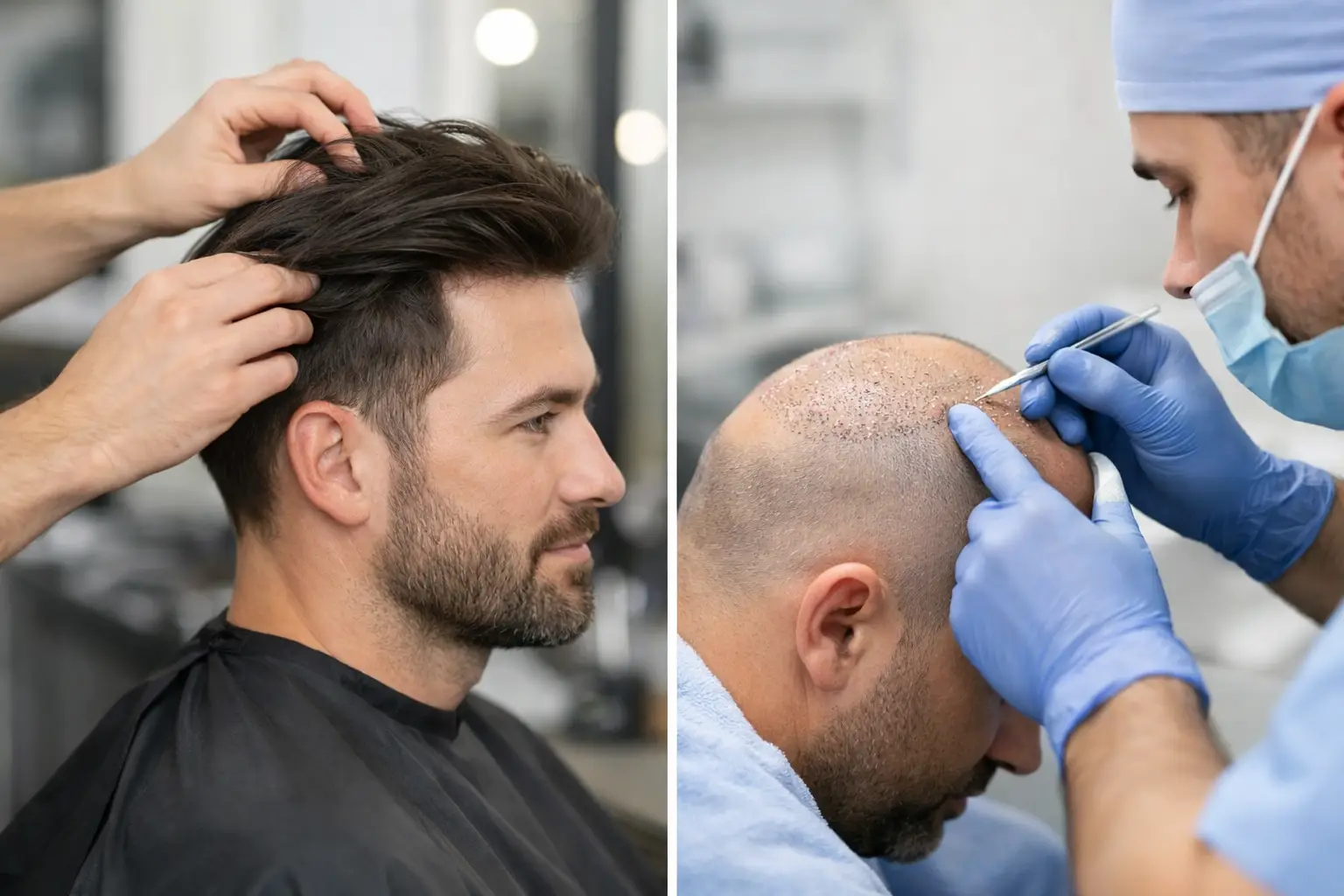
If you are weighing non surgical hair replacement vs transplant, you are probably not looking for theory. You want to know what will look natural, what will fit your lifestyle, how much commitment each option requires, and whether the result will actually help you feel like yourself again.
That is the real decision. Hair loss solutions are not just about hair. They affect confidence, daily routine, privacy, and how quickly you want to see a change. For some people, a transplant is the right long-term medical option. For others, non-surgical hair replacement offers a faster, more flexible, and less invasive path to a full head of hair.
Non Surgical Hair Replacement vs Transplant: The Core Difference
The biggest difference is simple. A hair transplant moves your own hair follicles from one part of the scalp to another through a medical procedure. Non-surgical hair replacement does not rely on moving follicles or waiting for new growth. Instead, it uses customized systems designed to blend with your natural hair and create immediate density and coverage.
That distinction shapes everything else, from timing and cost to maintenance and suitability.
A transplant is a biological solution. It depends on donor hair availability, scalp condition, hair loss pattern, and how your body responds after the procedure. Non-surgical hair replacement is a cosmetic and aesthetic solution, but that should not be mistaken for a compromise. Modern systems can look highly natural, especially when they are customized for hairline design, density, texture, and color matching.
When a Hair Transplant Makes Sense
A transplant can be a strong option for people with stable hair loss and enough healthy donor hair, usually at the back or sides of the scalp. Many patients choose it because they want their own hair growing from the scalp rather than wearing an external system.
There is clear appeal in that. Once transplanted hair grows in well, it can be cut, styled, and treated much like the rest of your natural hair. For the right candidate, it can deliver a lasting improvement.
But this is where expectations need to stay realistic. A transplant is not instant. You will not walk out with a full cosmetic transformation on day one. There is a healing period, followed by shedding and regrowth, and visible improvement often takes months. Depending on the extent of hair loss, more than one session may be needed.
Transplants also have limits. If your donor area is weak, your hair loss is very advanced, or your thinning is diffuse across the scalp, results may be less dramatic than you hope. In those cases, a transplant may still play a role, but often as part of a broader plan rather than a single answer.
When Non-Surgical Hair Replacement Is the Better Fit
For many adults, the appeal of non-surgical hair replacement is immediate. You do not need to wait for follicles to grow. You do not need surgery, stitches, or a lengthy recovery period. You can address visible thinning or baldness quickly and discreetly.
This makes it especially attractive for professionals, public-facing individuals, and anyone who wants privacy around treatment. If you have a busy schedule and do not want downtime, that matters.
It can also be the better choice if your hair loss is extensive, your donor hair is limited, or your condition is linked to medical treatment or health issues that make surgery less suitable. Non-surgical systems are often ideal for people who want control over their look, including density, hairline shape, and style.
That control is often underestimated. With a customized system, you are not just accepting whatever your scalp can produce. You are choosing the appearance you want to restore.
Appearance: Which Looks More Natural?
This is usually the first concern, and rightly so. No one wants a treatment that looks obvious.
The truth is that both options can look natural when done well, and both can look disappointing when poorly planned. A successful transplant depends on proper graft placement, suitable density, and realistic hairline design. A successful non-surgical system depends on customization, attachment technique, blending, and ongoing maintenance.
For someone with mild to moderate hair loss and good donor supply, a transplant can create a natural result over time. For someone with larger bald areas or a strong desire for fuller density, non-surgical hair replacement can sometimes deliver a more visually complete result right away.
This is an important point. A transplant may be natural, but not always dense enough in one session to create the fullness some patients expect. A non-surgical solution can often provide that fuller cosmetic effect immediately.
Cost: Upfront vs Ongoing Investment
Cost comparisons are not always straightforward because these options work differently.
A transplant usually involves a higher upfront cost. You are paying for a medical procedure, surgical expertise, and follow-up care. If you need multiple sessions, the total investment rises further.
Non-surgical hair replacement usually has a lower initial barrier compared with surgery, but it comes with ongoing maintenance and replacement over time. That means the better question is not which one is cheaper, but which one fits your budget style. Some people prefer a one-time medical procedure with long-term expectations. Others prefer a manageable recurring investment with immediate visual payoff.
There is also the issue of value. If a non-surgical system gives you the look you want now, with comfort and flexibility, that can be the more valuable choice for your situation even if maintenance is ongoing.
Lifestyle and Maintenance
Hair solutions do not exist in a vacuum. They become part of your routine.
A transplant demands patience in the beginning. You need recovery time, aftercare, and realistic expectations while waiting for growth. Later, you may still need medical support or hair loss management to protect existing non-transplanted hair.
Non-surgical hair replacement requires regular maintenance appointments, cleaning, adjustments, and eventual system updates. That does not make it inconvenient by default. For many clients, a structured maintenance schedule feels easier than surgery and waiting.
It comes down to what kind of commitment suits you better. Some people would rather maintain a polished result. Others would rather go through a procedure once and accept the slower road to visible change.
Non Surgical Hair Replacement vs Transplant for Men and Women
Men are often more familiar with transplants because they are widely marketed for male pattern baldness. But women and men both experience hair loss in ways that do not always match transplant-friendly patterns.
Women often have diffuse thinning rather than isolated bald patches, which can make transplant planning more complex. People with scarring, medical hair loss, or widespread density reduction may also find non-surgical options more practical. In these cases, the ability to create instant volume without depending on donor follicles can be a major advantage.
For men with receding hairlines and stable thinning, a transplant may be a strong option. For men with advanced baldness who want denser coverage now, non-surgical hair replacement can be more predictable cosmetically.
There is no single winner here. The right answer depends on your scalp, your hair loss pattern, and your goals.
Why Consultation Matters More Than the Internet Debate
Online comparisons often frame this as a battle between a real fix and a temporary fix. That is too simplistic.
A transplant is not automatically better because it is surgical. Non-surgical hair replacement is not automatically second best because it is not growing from the scalp. The right option is the one that gives you a natural result, fits your stage of hair loss, respects your budget, and works with your comfort level.
A proper scalp and hair assessment can reveal factors that generic articles miss. Is your hair loss stable or still progressing? Do you have enough donor density? Are you looking for subtle improvement or a major visual change? Do you want a medical procedure, or would you rather avoid one entirely?
At a specialist center like HairSpec, that wider view matters because treatment should be matched to the person, not forced into one category.
The Better Question to Ask
Instead of asking whether non-surgical hair replacement or transplant is better, ask which one is better for you right now.
If you want immediate coverage, flexibility, privacy, and a non-invasive solution, non-surgical hair replacement may be the more comfortable and satisfying path. If you are a strong surgical candidate, have realistic expectations, and want to pursue long-term biological regrowth, a transplant may be worth considering.
Some people even benefit from combining approaches over time, using non-surgical solutions now while planning future restorative treatment based on how their hair loss progresses.
The most confident decisions usually come from clarity, not pressure. When you understand the trade-offs, the choice gets easier – and the right solution starts to feel personal rather than generic.