

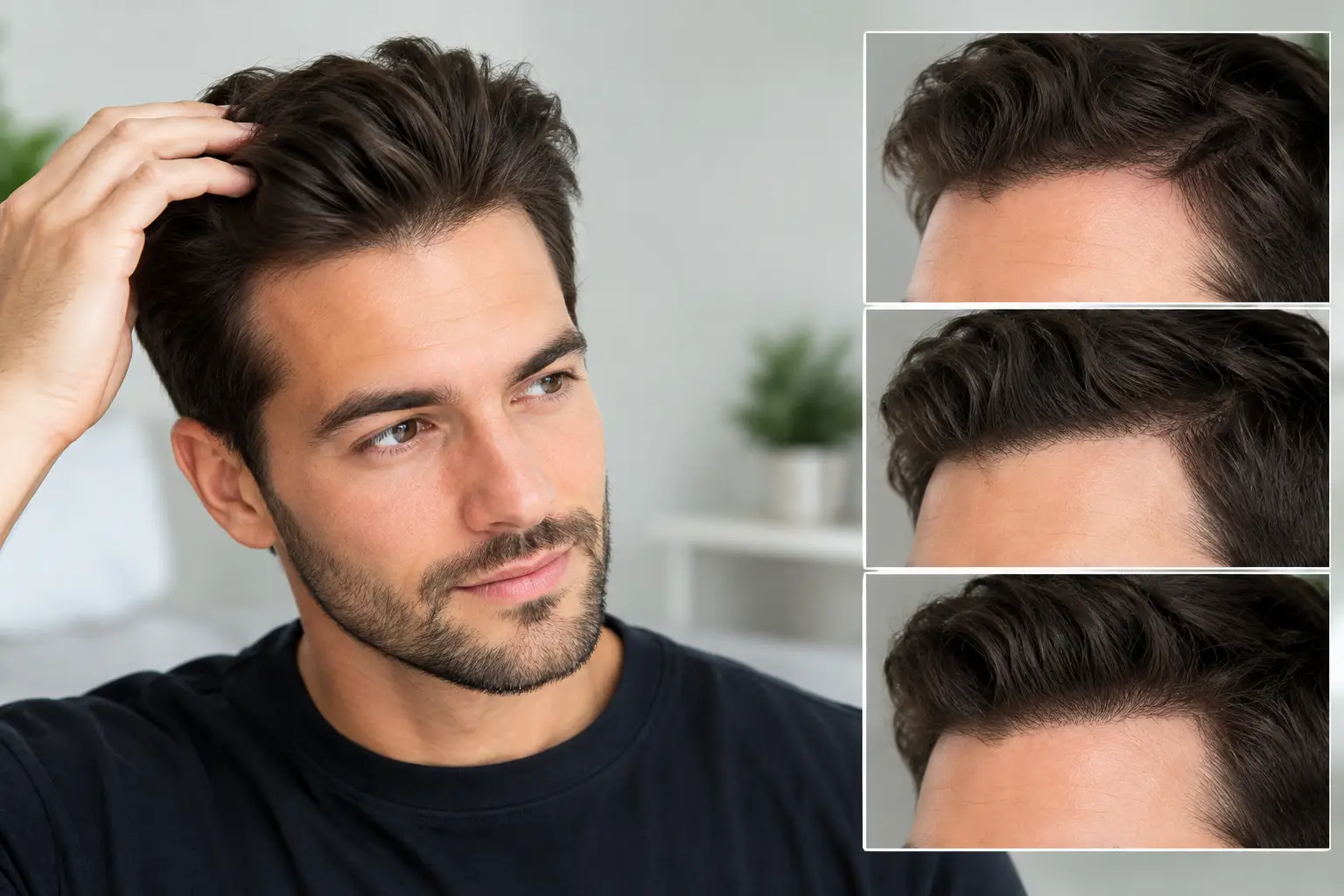
A hairline can look full and still look wrong. The giveaway is often not the hairline shape itself, but the density at the front: too thick, too dark, too uniform, or too disconnected from the hair behind it. Knowing how to select natural hairline density is what turns a hair restoration result from noticeable to convincingly your own.
Density should never be chosen from a single chart, celebrity photo, or a desire for the fullest possible look. A natural result accounts for your age, facial features, hair characteristics, pattern of loss, and the treatment path you choose. It also leaves room for how your hair may change over time.
What Hairline Density Actually Means
Hairline density refers to how much hair appears across the frontal edge of the scalp and through the area directly behind it. With a hair system, this may be described as a percentage density. With a hair transplant, it relates to graft placement and the number of hairs placed per square centimeter. With scalp micropigmentation, it is the visual concentration of pigment dots that creates the appearance of closely shaved follicles.
The key word is appears. Visual density is affected by more than the number of hairs. Thick, dark, straight hair against a lighter scalp can appear denser than fine, light, wavy hair, even when the actual hair count is similar. Hair length, styling direction, scalp visibility, and lighting all affect what others see.
A specialist should therefore assess density as part of the entire hairline design, rather than treating it as a number to maximize. The goal is not a solid wall of hair. It is a soft, believable transition from skin to hair that works at conversational distance, in photos, and under bright indoor light.
How to Select Natural Hairline Density for Your Features
A realistic front hairline has variation. In natural hair growth, the very first few millimeters are usually finer and less concentrated than the hair immediately behind them. There may be subtle irregularity in the outline, tiny changes in direction, and a gradual increase in fullness through the frontal zone.
Start with age and long-term appearance
A very dense, low hairline can be tempting, especially when hair loss has affected confidence. But an age-appropriate density usually creates the more convincing result. A hairline that may suit someone in their 20s can look out of place on a more mature face, particularly if the temples, crown, or sides have thinned.
This does not mean you have to accept a sparse result. It means building fullness in the right places. Many people benefit from a hairline that is soft at the edge, stronger one to two centimeters behind it, and balanced with the rest of the scalp. This approach can make hair appear full without creating an overly youthful or artificial frame for the face.
Match your natural hair characteristics
Your existing hair provides the best reference point. Consider its thickness, color, curl pattern, and how it sits when dry. Coarse, curly, or wavy hair often gives more coverage with moderate density. Fine, straight hair may require a different design to avoid visible scalp, but it should still retain a natural graduation at the front.
Color contrast matters as well. Dark hair on a light scalp creates stronger definition, so a highly dense hairline may look heavier than expected. Lower contrast between hair and scalp can allow for a softer appearance. For hair systems and wigs, a specialist can also consider root shading, hair direction, and front ventilation to reduce the appearance of density being packed into one area.
Look at the temples, not just the center
The center of the hairline receives the most attention in the mirror, but the temples often determine whether a result feels natural. A dense center with sharp, heavily filled temple points can make the hairline look drawn on. Conversely, a carefully tapered temple area can create a more realistic frame, even when the front has good coverage.
Men with pattern hair loss often need a design that respects natural temporal recession. Women with diffuse thinning may retain their frontal outline but need more visual density behind it. These are different concerns and should not be addressed with the same hairline template.
Density Choices by Treatment Type
The right density depends partly on how the result is created. Each option has distinct strengths and practical limits.
Non-surgical hair replacement and hair systems
Hair systems can deliver immediate fullness, making density selection especially important. Choosing the highest available density is rarely the safest choice. If your side and back hair are fine or thinning, an extremely dense top can look disconnected and may require more styling effort to blend.
A graduated front is usually preferable to a uniformly dense front edge. The intended hairstyle also matters. A brushed-back style exposes the hairline and needs fine, irregular ventilation at the front. A fringe can accommodate more density because the front is less visible, though it should still blend naturally when the hair moves.
Maintenance is part of the trade-off. Denser systems can feel warmer in Singapore’s humid conditions and may need more care to keep the hair looking light and natural. A consultation can help balance coverage, comfort, and the look you want day to day.
Scalp micropigmentation
Scalp micropigmentation, or SMP, creates the impression of density rather than adding physical hair. It can be effective for a closely shaved appearance, to reduce contrast in thinning areas, or to support the look of a transplanted or non-surgical result.
With SMP, a conservative hairline is especially important. Pigment should mimic the soft diffusion of real follicles, not form a hard border. The density must also be built in stages so the practitioner can evaluate how it heals against your skin tone and natural hair. A slightly softer first session can be deepened later. Removing an overly dark or overly low design is much more difficult.
Hair transplant planning
A transplant must work within the limits of the donor area. Even when a patient has good donor supply, grafts should be allocated strategically. The frontal hairline needs fine, single-hair grafts and careful placement, while the mid-scalp and crown may need coverage as hair loss progresses.
Pursuing maximum frontal density can use grafts that may be needed later. For this reason, a mature hairline with realistic density often provides a better long-term plan than a very low, packed design. Existing hair loss, family history, and future treatment options should all be considered before transplant placement.
Common Density Mistakes to Avoid
The most common problems happen when a hairline is viewed as a separate cosmetic feature instead of part of the whole scalp. Be cautious of these four choices:
- Choosing density based only on a younger photo, without considering current facial proportions or future thinning.
- Creating the same density from the first row of hair through the entire frontal area, which removes the natural transition zone.
- Ignoring contrast between your hair color, hair texture, and scalp tone.
- Matching the front hairline to an ideal image while overlooking thinning at the temples, mid-scalp, or crown.
A natural hairline does not need to be perfectly symmetrical. Small differences in contour and density often make it look more authentic. The aim is controlled irregularity, not a jagged or messy outline.
What to Discuss During a Hairline Consultation
A quality consultation should include more than selecting a hairline position with a marker. Ask how the proposed density will blend with your existing hair, how it will look under direct light, and how it may be adjusted if your hair loss changes. If you wear your hair in more than one style, discuss each of them.
It is also useful to bring a few reference photos, but use them as a conversation starter rather than a fixed instruction. A good result should suit your face and hair type, not copy another person’s genetics. Your specialist may suggest a slightly different density than you expected for a more natural outcome.
At HairSpec, a scalp assessment can help identify whether a hair system, SMP, transplant approach, or combination plan better suits your goals, existing hair, and comfort level. For medically related hair loss or sudden changes in shedding, professional medical evaluation may also be appropriate before making a cosmetic decision.
The best density is the one that gives you the freedom to stop thinking about your hairline. When the design respects your natural features and has room to age well, confidence tends to follow without needing to announce where it came from.