

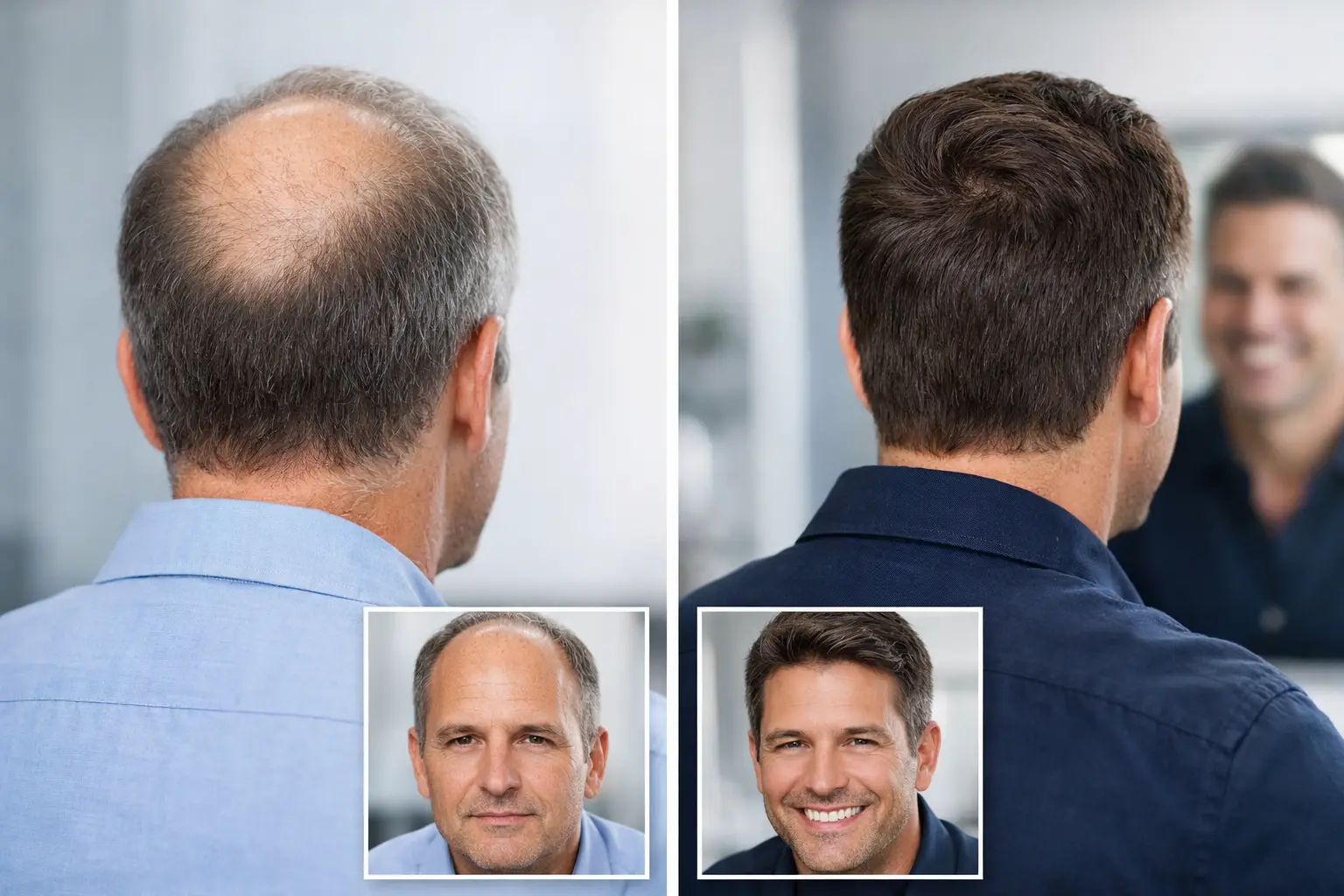
Most people do not ask for hair replacement before after examples because they want dramatic marketing shots. They ask because they want proof that the result can look believable in daylight, at work, and in photos taken from every angle. That is a much better question, because the most successful outcome is not the one that looks biggest on camera. It is the one that looks like your hair belongs to you.
When you are comparing treatments, before-and-after images can be useful, but only if you know what you are really looking at. Hair density, hairline design, scalp visibility, texture match, and styling flexibility all matter more than a simple “more hair” impression. The right example should help you picture what is realistic for your age, hair loss pattern, and lifestyle.
What good hair replacement before after examples actually show
A strong before-and-after set should show more than a transformation. It should show suitability. If the before photo reveals diffuse thinning at the crown, the after photo should not only hide the scalp better but also preserve a natural density gradient. Real hair does not appear equally thick from front to crown, and a result that ignores that can look artificial very quickly.
The best examples also show how the hairline has been handled. A natural hairline is rarely straight, dense, and perfectly symmetrical. It usually has subtle irregularity, softer density at the front edge, and a shape that fits the client’s face. This is especially important for people considering non-surgical hair replacement, hair systems, or transplant work. A result can be technically full and still look wrong if the hairline has been designed without restraint.
Lighting tells its own story too. Flat studio lighting can make almost any result look thicker. More honest examples include different angles, normal indoor lighting, and close enough views to assess blending. If the after image only shows one flattering angle with heavy styling product, it may be hiding the details you actually need to see.
Different treatments create different before-and-after results
One reason people get confused by galleries is that not all solutions are meant to create the same type of change. Hair replacement, scalp micropigmentation, hair transplant surgery, and density-enhancing services all solve different problems. The right example depends on the goal.
Non-surgical hair replacement
For clients with moderate to advanced hair loss, non-surgical hair replacement can create the most immediate visual change. In before-and-after examples, the difference is often visible right away because the system restores coverage, shape, and style in one appointment cycle. The strongest examples show a result that matches the client’s age, face shape, and existing side and back hair. If the top looks too thick compared with the perimeter, it can feel obvious even to someone who cannot explain why.
This option tends to suit people who want fast improvement, privacy, and control over their final look. The trade-off is maintenance. Good examples should make the finish look natural, but they should also reflect realistic wearability, not just a freshly styled salon result.
Hair transplant results
Transplant before-and-after examples usually tell a slower story. The most accurate comparisons are months apart, not days apart, because transplanted follicles need time to settle and grow. A good transplant result often looks more subtle than people expect at first glance, especially if the starting point was significant loss. What matters is whether the new growth softens the hairline, improves framing, and increases visible density in a way that still looks natural.
Transplants can be a strong fit for some clients, but donor hair quality, extent of loss, and long-term progression all affect the final outcome. That is why “it depends” is not a vague answer here. It is the truth.
Scalp micropigmentation
Scalp micropigmentation does not add hair, so before-and-after examples should be judged differently. The visual improvement comes from reducing the contrast between hair and scalp. On a shaved or closely cropped style, this can recreate the appearance of fuller coverage. In thinning areas, it can make existing hair look denser. The best examples show a softer, more natural scalp tone rather than a harsh painted effect.
Wigs, toppers, and medical hair solutions
For women and men experiencing medical or widespread hair loss, the most helpful before-and-after examples focus on comfort, realism, and integration with everyday life. A good result should complement skin tone, face shape, and preferred styling habits. Volume is not the only goal. Movement, parting, and natural placement matter just as much.
How to read before-and-after photos without getting misled
Hair replacement before after examples can be persuasive, but they are not all equally honest. A few details can change how a result appears.
The first is angle. If the before shot is taken from above and the after shot is taken straight on, the comparison is already distorted. The second is hair length. Longer hair can cover thinning more effectively, so the visible improvement may come from styling rather than treatment quality alone. The third is scalp condition. Dryness, redness, or fresh application can change the appearance of both scalp and density.
It also helps to ask what happened between the photos. Was it a new system installation, a transplant after full growth, a fresh cut-in, or a styled finishing session? None of those are wrong, but they are not the same thing. The more context you have, the better you can judge the result fairly.
What realistic improvement looks like
A realistic result does not always mean a complete reversal of hair loss. In many cases, success is about making hair look consistent, balanced, and age-appropriate. For some people, that means a restored front hairline. For others, it means reducing scalp show-through at the crown or creating enough density to style hair with confidence again.
This matters because the most satisfying outcomes are usually personalized, not exaggerated. A conservative hairline may look better over time than an aggressively low one. Moderate density that blends naturally may be more convincing than maximum fullness. The right after photo should make you think, “That person looks better,” not, “That treatment looks obvious.”
Matching the example to your hair loss pattern
Before-and-after galleries are only useful if the person in the image resembles your starting point. A client with temple recession should not compare themselves to someone with diffuse thinning across the top. A woman with part-line widening should not judge her likely result against a fully customized men’s hair system. Hair loss pattern, hair texture, scalp color, and styling routine all influence the final look.
That is why consultation matters. A specialist should be able to explain which examples are relevant to your case and which are not. More importantly, they should explain why. Sometimes the best option is not the most dramatic one. A person wanting low maintenance may prefer scalp micropigmentation over a full hair system. Someone with stable loss and strong donor supply may be a better transplant candidate. Another person may want a non-surgical solution first because they need immediate improvement while considering long-term treatment.
At HairSpec, this consultation-led approach matters because hair loss is rarely just one issue. Coverage, scalp health, maintenance tolerance, budget, and styling goals all need to be weighed together.
Questions worth asking when reviewing examples
When you see a result you like, do not stop at “Can I get that too?” Ask what the client started with, what service was used, how long the result took, and what upkeep is involved. Ask whether the look is achievable with your current hair on the sides and back. Ask how the result will hold up in Singapore’s humidity if that is relevant to your daily life. Ask what it looks like unstyled.
These questions tend to lead to better decisions than chasing the most dramatic gallery image. They move the conversation from fantasy to fit.
Why natural-looking results matter more than dramatic ones
Hair restoration is personal. Most clients are not trying to look like a different person. They want to look like themselves again, or perhaps like a more rested, more confident version of themselves. That is why the strongest before-and-after examples are often the least flashy. They show believable density, thoughtful design, and a result that supports the person’s features instead of overpowering them.
If you are evaluating options, use photos as a starting point, not a promise. The real value of hair replacement before after examples is not just showing change. It is showing what kind of change is possible when the treatment matches the person. That is where confidence starts to feel real again.