

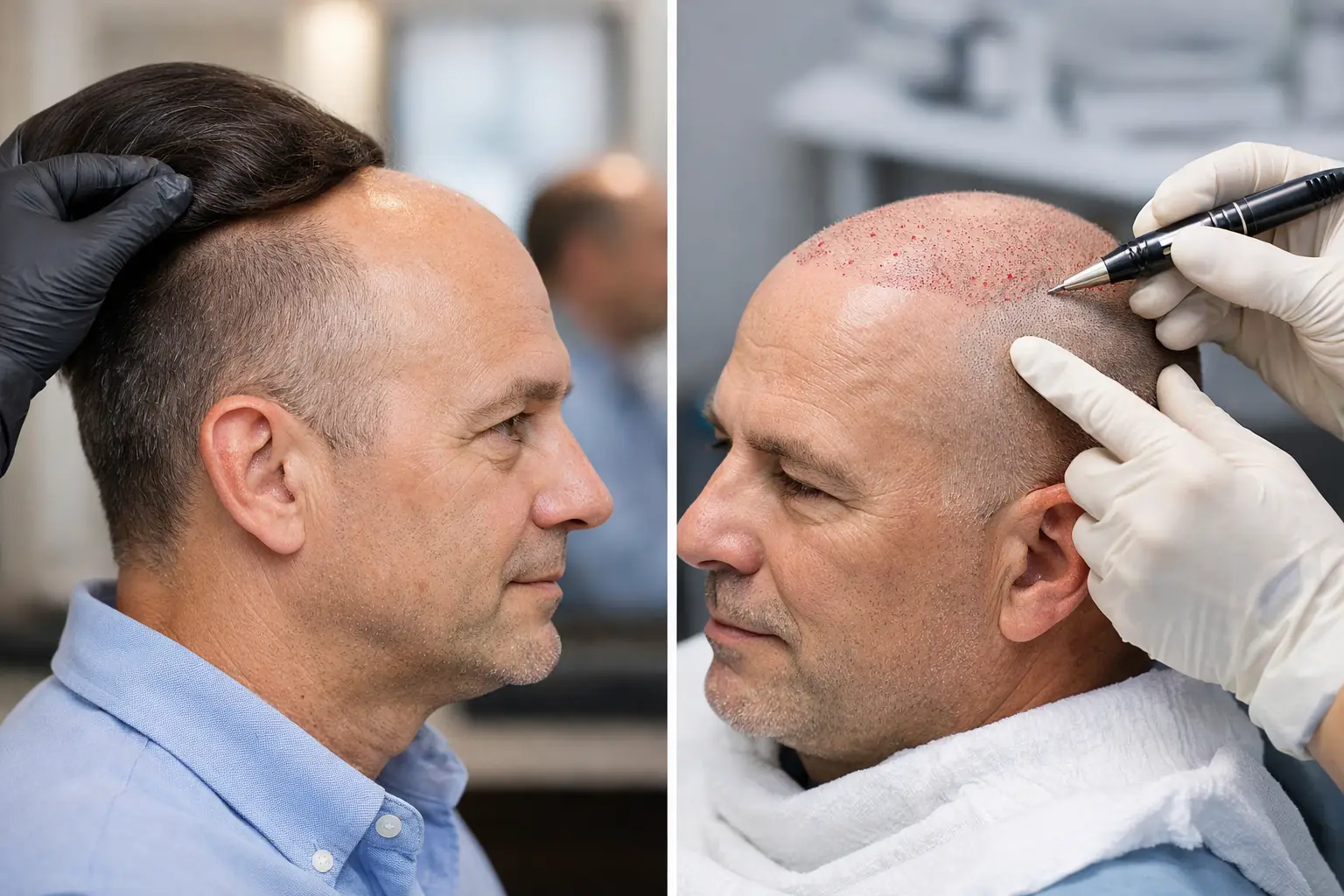
A lot of people start with the same question, but what they really mean is more personal: in the hair replacement vs transplant decision, which option will let me look like myself again without turning my life upside down? That is the right place to begin, because hair loss treatment is not only about technique. It is about comfort, visibility, timing, budget, and how much control you want over the final result.
The short answer is that neither option is automatically better. A hair transplant can be a strong long-term solution for the right candidate, while non-surgical hair replacement can deliver immediate density, flexible styling, and a natural-looking appearance without surgery. The better choice depends on your pattern of hair loss, the quality of your donor hair, your expectations, and how quickly you want to see change.
Hair replacement vs transplant: the core difference
A hair transplant is a medical procedure that moves your own hair follicles from one area of the scalp, usually the back or sides, to areas affected by thinning or baldness. Because it uses your existing hair, the goal is permanent growth in the transplanted areas. Results can look very natural, but they take time, and not everyone is an ideal candidate.
Hair replacement is different. It is a non-surgical approach that adds the appearance of hair through advanced systems, custom-fitted solutions, or other cosmetic restoration methods. Depending on the method used, it can restore density, cover thinning, or create a full head of natural-looking hair almost immediately. For many people, that speed and flexibility are a major advantage.
This is why the comparison can feel tricky. One option is surgical and gradual. The other is non-surgical and immediate. One depends heavily on the hair you still have. The other can work even when loss is more advanced.
Who usually does best with a transplant?
A transplant tends to suit people with stable hair loss, enough healthy donor hair, and realistic expectations about density and timing. It can work well for men and women with pattern hair loss who want a permanent solution using their own follicles.
But there are limits. If your hair loss is diffuse, your donor area is weak, or your scalp condition is not ideal, transplant results may be less predictable. It also may not be the best first step if you want dramatic change quickly. Hair grows in phases, so visible improvement usually takes months rather than days.
There is also the question of progression. If your hair loss continues after surgery, you may need ongoing medical management or even future procedures to maintain balance between transplanted and non-transplanted areas. A transplant is not a shortcut around the biology of hair loss.
Who usually does best with hair replacement?
Hair replacement is often the better fit for people who want immediate improvement, prefer to avoid surgery, or have more extensive thinning that makes transplantation less suitable. It can also be an excellent choice for medical hair loss, temporary shedding, or clients who want greater control over volume, density, and hairline design.
This matters more than many people realize. Some clients are less concerned with whether the hair is surgically grown and more concerned with whether they can walk into work, attend events, and feel confident right away. In those cases, non-surgical replacement can be life-changing.
Modern systems are also far removed from outdated assumptions about obvious wigs or unnatural coverage. When fitted and maintained properly, high-quality replacement solutions can look refined, realistic, and highly personalized. Texture, density, color match, and styling all play a role.
Cost, recovery, and maintenance
When comparing hair replacement vs transplant, people often focus on upfront cost alone. That is understandable, but it is not the full picture.
A transplant usually involves a higher initial investment. You are paying for a medical procedure, surgical expertise, and a long-term plan. There is downtime to consider, along with aftercare, healing, and the waiting period for growth. For some, that investment makes perfect sense because they want a permanent approach and are comfortable with delayed results.
Hair replacement usually has a lower barrier to entry, but it does require regular upkeep. Depending on the solution, you may need maintenance appointments, replacement cycles, cleaning routines, or periodic adjustments. That does not make it less valuable. It simply means the cost structure is ongoing rather than heavily front-loaded.
Recovery is another major difference. A transplant involves healing, sensitivity, and a temporary period where the scalp may show signs of the procedure. Hair replacement avoids surgical recovery, which is one reason many professionals and public-facing clients prefer it. They can improve their appearance without taking extended time away from daily life.
What about natural-looking results?
Both options can look natural when they are done well, and both can look disappointing when they are poorly planned.
A well-executed transplant should follow natural growth direction, hairline design, and density distribution. The challenge is that natural-looking outcomes rely on artistry as much as technique. If too many grafts are placed too aggressively at the front, or if the hairline is designed without regard for age and facial structure, the result can feel unnatural even if the surgery itself was technically successful.
Hair replacement also depends on customization. The best outcomes come from tailored fitting, realistic density, careful color blending, and proper styling. A natural result is rarely about one single element. It comes from how everything works together on your scalp, with your features, and within your lifestyle.
This is where consultation matters. A specialist should not push one category of solution simply because it is what they offer. They should assess your scalp, hair loss pattern, expectations, and maintenance preferences before making a recommendation.
Hair replacement vs transplant for different lifestyles
If you value a one-time medical intervention and are comfortable waiting for gradual change, a transplant may align with your goals. If you want immediate confidence, more styling control, and a non-invasive route, hair replacement may feel more practical.
Lifestyle often decides the issue faster than clinical theory. Someone with a demanding schedule may not want surgery, healing time, or the appearance changes that happen during the growth phase. Someone else may prefer to invest in a transplant because they want to work with their own biological hair over the long term.
There is also a psychological side to this choice. Some clients feel most comfortable with a non-surgical solution because it gives them flexibility. Others feel most reassured by a medical procedure designed for permanence. Neither reaction is wrong. The right path is the one you can commit to with confidence.
When a combined approach makes sense
Not every case has to be treated as an either-or decision. In real practice, combination planning can be very effective.
For example, a person may use non-surgical hair replacement while waiting for transplant candidacy, or while deciding whether surgery is right for them. Someone who has had a transplant may still benefit from scalp micropigmentation, low level laser therapy, or density-enhancing solutions to improve the overall appearance. A client with ongoing thinning may start conservatively and move into more advanced treatment later.
This is one reason a full-spectrum provider is valuable. The best recommendation is not always the most aggressive one. It is the one that matches your current condition and leaves room for smart next steps.
Questions worth asking before you choose
Before moving forward, ask yourself a few practical questions. Do you want visible change now or are you comfortable waiting? Are you open to surgery? Is your hair loss mild, moderate, or advanced? Do you want a solution with less maintenance over time, or do you prefer one that gives you more immediate control over your look?
You should also ask what success means for you. For some people, success is filling in the hairline. For others, it is restoring full coverage, looking younger on video calls, or feeling comfortable under bright lighting again. The best treatment plan starts there, not with a generic label.
At HairSpec, this is why personalized assessment matters so much. Hair loss rarely follows a script, and the right solution should be based on your scalp, your goals, and how you want to live with the result.
Which option is right for you?
If you are choosing between hair replacement and transplant, the most useful mindset is not to ask which one is better in the abstract. Ask which one fits your hair loss, your timeline, and your comfort level best.
A transplant may be the right move if you are a strong candidate, want a long-term surgical solution, and have the patience for gradual growth. Hair replacement may be the stronger choice if you want immediate density, non-surgical treatment, privacy, and more control over your appearance. Many people are surprised to learn that the most satisfying result often comes from matching the solution to the person, not chasing what sounds most permanent.
Hair loss can make you feel like your options are narrowing. In reality, the right specialist should help you see the opposite – that there are several ways forward, and the best one is the one that helps you feel comfortable, natural, and fully yourself again.