

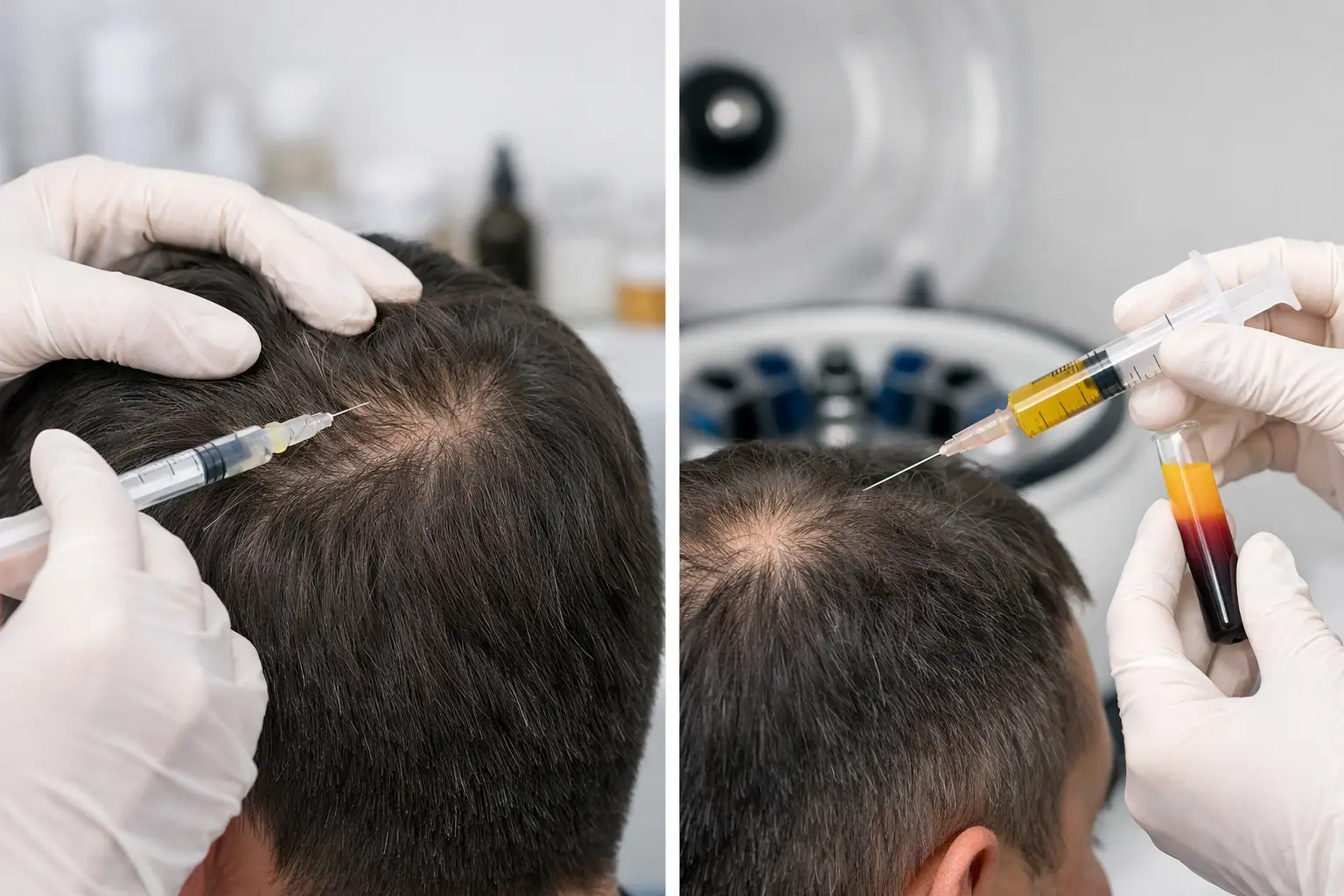
A widening part, more scalp showing under office lighting, or extra hair in the shower can make every treatment claim feel urgent. When comparing mesotherapy versus PRP hair treatment, the better choice is rarely the one with the boldest promise. It is the one that matches the cause of your hair loss, the condition of your scalp, your comfort with needles and downtime, and the result you realistically want to see.
Both treatments are non-surgical, injection-based options often considered for thinning hair. Both may be used as part of a broader hair restoration plan. Yet they work differently, rely on different materials, and have different levels of research support. A professional scalp assessment helps separate what may support your existing hair from what may be better addressed with hair replacement, scalp micropigmentation, medication, or transplant planning.
Mesotherapy versus PRP hair: the key difference
Mesotherapy delivers small, targeted injections of selected ingredients into the scalp. Depending on the clinic and treatment plan, the formula may include vitamins, minerals, amino acids, peptides, hyaluronic acid, or hair-supporting compounds. The goal is to improve the scalp environment and provide localized support to follicles that are still active.
PRP, short for platelet-rich plasma, begins with a small sample of your own blood. The blood is processed to concentrate platelets and plasma, then the prepared PRP is injected into areas of thinning. Platelets contain growth factors involved in tissue repair and cell signaling. In hair restoration, PRP is intended to encourage healthier follicle activity and may help reduce shedding or improve the caliber of existing hairs in suitable candidates.
The practical distinction is simple: mesotherapy uses an externally prepared cocktail, while PRP uses a concentrated component of your own blood. That difference affects the appointment process, treatment cost, and how consistently protocols can be compared between providers.
What mesotherapy may be best for
Mesotherapy can appeal to people who want a relatively quick, non-surgical scalp treatment without having blood drawn. It is commonly considered when the scalp feels dry, congested, or poorly conditioned, or when early thinning is accompanied by fragile-looking hair. Some clients also choose it as a supportive treatment alongside laser therapy, hair spa care, or a wider hair wellness program.
Its strongest appeal is flexibility. A practitioner can tailor the formula to your scalp and hair concerns, which may be helpful when treatment is focused on scalp quality as well as visible density. Sessions are generally short, and normal activities can often resume the same day, although you may be asked to avoid washing your hair, intense exercise, heat exposure, or swimming for a brief period.
That flexibility also creates an important trade-off. Mesotherapy formulas are not standardized across providers. Ingredients, concentrations, injection depth, and session schedules can differ substantially. This makes it harder to make a direct, apples-to-apples comparison of results. Ask exactly what is being used, why it has been selected for your scalp, and what outcomes are realistic for your pattern of loss.
Mesotherapy is not a way to regrow hair across a smooth, long-standing bald area where follicles are no longer viable. In that situation, a hair transplant, scalp micropigmentation, or a natural-looking non-surgical hair replacement solution may offer a more visible and reliable cosmetic change.
What PRP may be best for
PRP is most often discussed for people with early to moderate thinning, especially androgenetic alopecia, also known as male- or female-pattern hair loss. It may be considered when hair follicles are producing thinner, shorter strands but remain present. Some people use PRP alongside medically guided hair loss treatment, while others include it after a hair transplant to support the overall restoration plan.
Compared with mesotherapy, PRP has a clearer body of published clinical research in pattern hair loss, although results still vary. Studies differ in how PRP is prepared, how often it is injected, and how success is measured. That means PRP should not be presented as a guaranteed cure. It may help some suitable candidates improve hair shedding, density, or strand thickness, but it will not restore every hairline or reverse advanced loss.
Because PRP comes from your own blood, there is no donor material or added vitamin cocktail being injected. However, the treatment does involve a blood draw and processing step before scalp injections. Appointments may therefore take longer than mesotherapy. People who dislike blood draws, have certain blood or platelet disorders, use blood-thinning medication, or have an active scalp infection may not be appropriate candidates without medical clearance.
A typical PRP plan often begins with a series of sessions spaced several weeks apart, followed by maintenance treatments. Hair grows slowly, so assessment should be based on standardized photos and professional review over months, not day-to-day mirror checks.
Comfort, recovery, and cost considerations
Both treatments use multiple small scalp injections. Most clinics apply topical numbing cream or use techniques intended to improve comfort, but sensitivity varies. You may experience temporary tenderness, pinpoint bleeding, mild swelling, redness, or a headache afterward. These effects usually settle quickly, but your provider should explain what is normal and when to seek medical advice.
PRP may feel more involved because it includes the blood draw. Mesotherapy can feel more straightforward, though the experience depends on the injection method and treated area. Neither procedure should require significant downtime, but it is sensible to schedule your first session when you do not have a major event immediately afterward.
Cost is another point where a direct comparison can be misleading. PRP often costs more per session because of blood collection and processing, while mesotherapy pricing depends on the formulation and number of scalp areas treated. The meaningful question is not simply which treatment has the lower first-session price. Consider the recommended course, maintenance requirements, expected level of improvement, and whether the plan addresses your actual cause of hair loss.
How to choose between mesotherapy and PRP
Start with a diagnosis, not a procedure. Hair thinning can result from pattern hair loss, stress-related shedding, hormonal changes, nutritional deficiencies, inflammatory scalp conditions, traction, medication, or medical treatment. An injection treatment cannot replace proper evaluation when shedding is sudden, patchy, painful, or accompanied by scaling and irritation.
Mesotherapy may be worth discussing if your priority is targeted scalp nourishment, you prefer not to have blood drawn, and your specialist believes your follicles are still responsive. PRP may be a stronger conversation to have if you have early pattern thinning and want an autologous treatment with more clinical attention behind it.
For many people, the answer is not strictly one or the other. A personalized plan may combine scalp treatments with low-level laser therapy, physician-directed care, nutrition review, or cosmetic density solutions. If you need an immediate visual change while you treat underlying thinning, modern non-surgical hair replacement can provide natural-looking coverage without waiting months for biological hair growth.
Questions to ask at your scalp assessment
A credible recommendation should be specific, not sales-driven. Ask what type of hair loss you appear to have, whether your follicles are likely to respond, and how progress will be measured. You should also ask about the exact mesotherapy ingredients or PRP preparation method, the recommended number of sessions, expected maintenance, possible side effects, and the full estimated cost.
It is equally reasonable to ask what happens if the treatment does not deliver the hoped-for improvement. A specialist who offers several pathways can discuss alternatives openly, rather than forcing every concern into a single procedure.
The most reassuring hair loss plan is one that gives you clarity and control. Whether mesotherapy or PRP is appropriate, choose a provider who examines your scalp carefully, sets realistic expectations, and keeps your comfort, privacy, and confidence at the center of the decision.